1720-1781
As the friend of Whitefield, the Tennents, Presidents Edwards, Burr, and Dickinson; as the trustee for twenty-six years of the College of Princeton; as the Moderator of the Old Synod of New York and Philadelphia; as one selected to fill the place of President Edwards at Stockbridge, on his transfer to Nassau Hall; as a chaplain in the Old French War on the frontiers of Canada; as the first domestic missionary of the Presbyterian Church in the United States; as a faithful missionary to the Indians for more than twenty years; and, above all, as a holy and consecrated man of God…
The Life of John Brainerd
Map of general Brainerd locations see below for specific addresses.
Early Life and Family
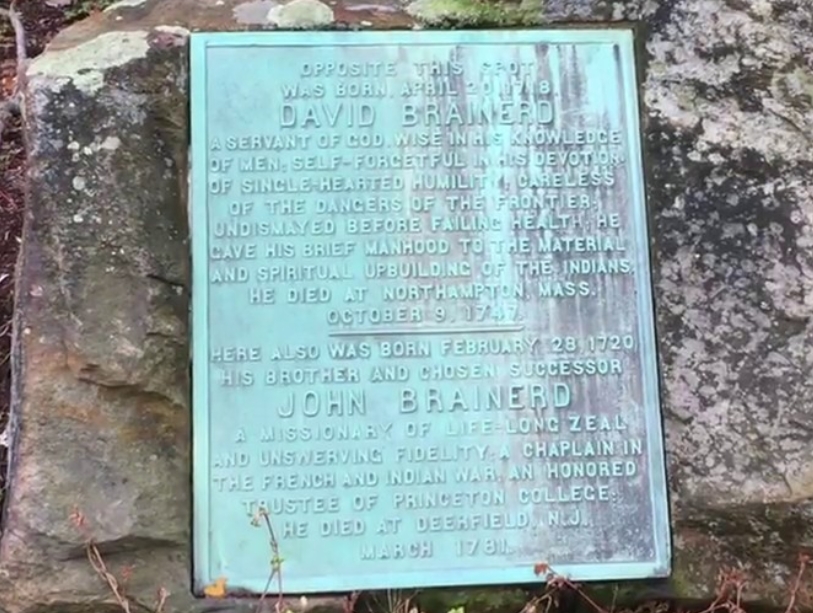
John Brainerd was born to Hezekiah and Dorothy Brainerd in Haddam, CT February 28, 1720. One of 9 children and brother to the more famous Indian missionary, David Brainerd. Their father died in 1927 (age 46) when he was 7 and his mother in 1732 (age 52) when he was 12.
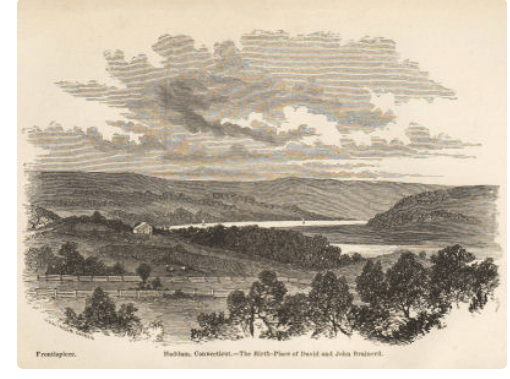
“… born in Haddam, CT of a substantial family whose house, standing back from the river, overlooked a fine view of groves and fields. His father, an official representative of the king in the provincial government…” Dodds
marker located on the western side of Walkley Hill Road near the northern intersection of Route 154
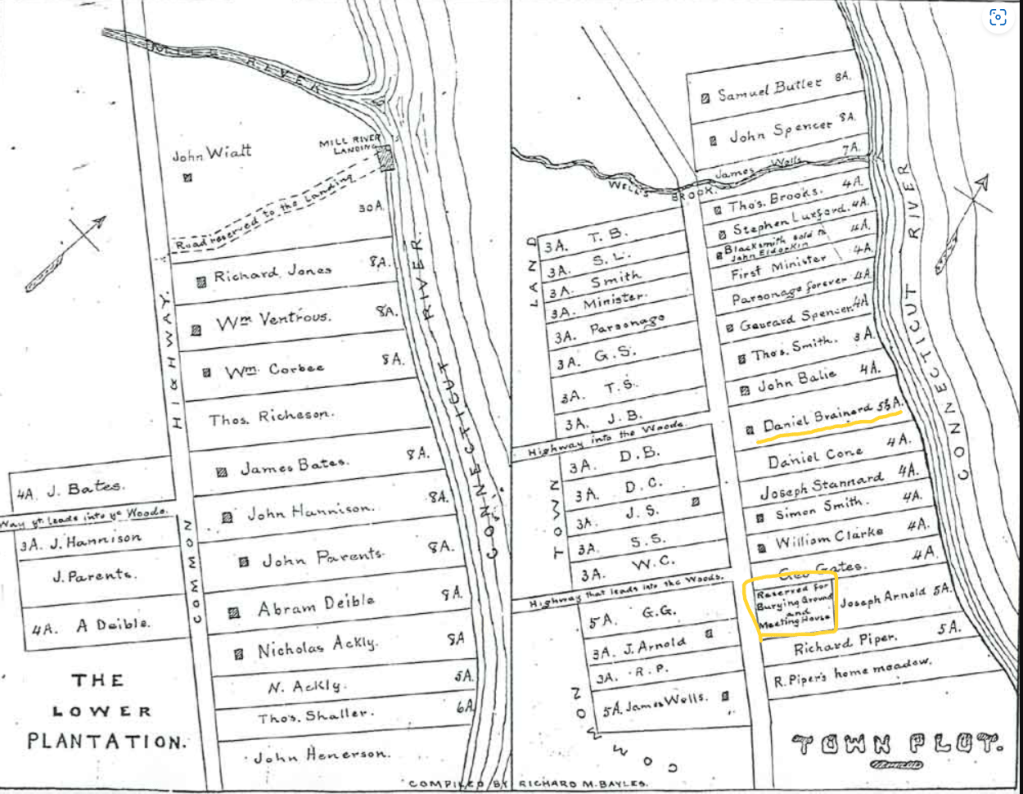
John married his first wife Experience Lyon of New Haven, CT in early 1752 while he was living in Cranbury. Perhaps they knew each other from his time as a student at Yale. She bore him three children and died in 1757 after only 5 1/2 years of marriage at age 38. She is buried in New Haven. Two of the children died a year later at ages 5 and 1 1/2. Mary would be his only surviving child, she lived to the age of 36.
He would marry his second wife, Elizabeth Price of Philadelphia in 1766 when Mary was 11. They had no children together. She survived him for 7 years until 1788. It is believed she resided alternately with Mary in Mount Holly and her own relatives in Philadelphia until her death. Her grave is unknown.
“Between her (Elizabeth) and her step-daughter Mary, the only surviving child of John Brainerd, there seems to have subsisted a most tender, delicate, and permanent affection, which found expression in constant intimacy and correspondence. The letters of the daughter to her step-mother are marked by so much filial love, piety, taste, and refinement of feeling as to indicate on the part of her father great care in her training and an excellent parental example: they do credit alike to the father, mother, and daughter.”
I will rely on and quote heavily from the The Life of John Brainerd by his relative Thomas Brainerd as not enough has been written about this godly and faithful man.
1747-1755 Bethel Mission – Cranbury, NJ
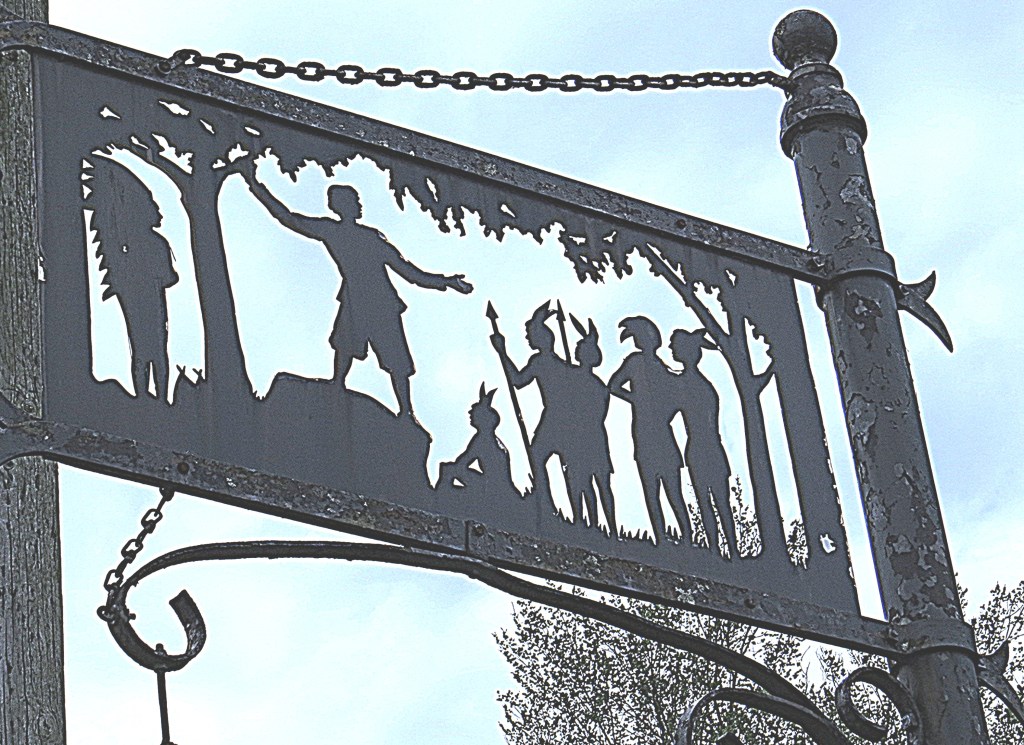
“April 14, 1747 – this day my brother went to my people.“
~David Brainerd
John trained for the ministry at Yale continuing on after his brother was kicked out, and when in 1747 David died at age 29 from tuberculosis, he took over his ministry to the Indians in Cranbury, New Jersey. Read this post for information about David’s early years of the Bethel mission. (It is thought the current Monroe High School was built on the mission site.)
“The one must leave his dying brother for the field of duty; the other was regretting weakness, pain, and approaching death, only as they cut short his pious labors. The letter subsequently addressed by David to John may well be taken as an index of the “conversation” between the brothers. John, now but twenty-seven years old, without experience as a minister or missionary, unaccustomed to Indian life and forest-fare, ignorant of the language of the people and a stranger to the localities of their neighborhood, had a thousand queries to propose and a thousand perplexities to be solved. No man ever had a better apology for self-distrust and shrinking at the outset of a great enterprise. On the other hand, David would have a thousand things to tell concerning his Indians, and, with his high standard of life and labors, a thousand solemn charges to impose. We can all readily picture the interest of this brief interview. As we know the keen, almost morbid, sensibility of these young men, their matter-of-fact arrangements for duty show how they had subordinated every human sympathy to the obedience of Christ.”
John served the Indians at the Bethel mission in Cranbury until May 7, 1755. He had ministered to them about 8 years. There had begun to be disagreements over the land ownership, and he was asked to move to Newark to fill the pastorate left vacant by Aaron Burr. Burr moved to serve as the president of the College of New Jersey at Princeton. William Tennent Jr. would be given care of the Indians until a suitable place was found for them. This was his ultimate hope, it would have some setbacks for a few years.
1755-1759 Newark, NJ
“the people of Newark have since had a society meeting and voted unanimously to give me a call upon probation…This seems to look like a call in Providence, and certainly suggests duty. But, for my part, I cannot but look upon myself as very unequal to the work, and can truly say I had rather continue in the mission if any suitable provision could be made for the re-settlement of the Indians and the comfortable support of the mission” John Brainerd letter to Eleazer Wheelock
John served at Newark’s First Presbyterian Church until June 1756, he had reason to hope land would be purchased for the Indians.
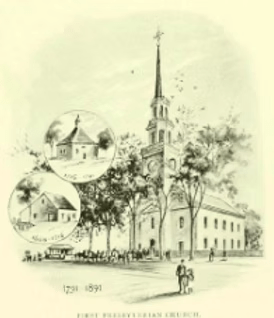
He reflects back on the year 1757, “I moved with my family to Newark, and continued there till June, 1756, when the (Scottish) Correspondents, thinking they had a prospect of procuring the land on which the Indians are now settled, requested me to resume the mission, with which I complied ; and, giving up the call I had to settle at Newark, moved with my family to Brunswick, being the best place I could now fix to accommodate the Indians in their present situation, till the land for their settlement could be procured. In this situation I continued till September, 1757, when the Correspondents, being disappointed, and seeing no way to procure the land, dismissed me a second time ; and the congregation at Newark, having continued all this time unsettled, renewed their call to me the next week, which I soon after accepted, moved again with my family, and settled there.“
He may have been involved with Bethel again at this time from June 1756-Sept 1757. But, after a year and a half of waiting for land, he found himself back in Newark at the church. As soon as he moved back to Newark his wife died, only one week after Aaron Burr had died.
He writes, “You have doubtless heard the choice the trustees have made of the Rev. Mr. Edwards to succeed our late excellent President Burr, whose death occurred just a week (September 29, 1757) after the most affecting breach upon my family, by which was removed the dearest of my earthly enjoyment (Experience died on on the 17th) This sorrow you have heard long before, and, I doubt not, sincerely mourned with me. Let me, dear sir, have your prayers for me and my dear little offspring, who have lost a most valuable friend.”
A few months later, Dec 1757, he would be sent by the Trustees of Princeton to Stockbridge, MA. They hoped he would be able to convince Jonathan Edwards to come to Princeton.

Trustee minutes Dec 1757
Edwards did reluctantly go to Princeton (and died 6 weeks later in March of 1758) and unexpectedly Stockbridge asked John to fill his place and bring his Indians with him.
“The council of ‘ministers in Stockbridge, at the request both of the English and Indian congregations at Stockbridge, addressed a letter to the Commissioners in Boston, requesting that the Rev. John Brainerd might be appointed Mr. Edwards’ successor ; the Housatonnucks offering land for a settlement to the Indian congregation at Cranberry, New Jersey, if they would remove to Stockbridge ; and another letter to the trustees of the college requesting that they use their collective and individual influence to procure the appointment of Mr. Brainerd and his removal to Stockbridge.”
This, for some unknown reason, did not happen likely because his heart was firmly resolved to minister to the Indians in New Jersey, and so he was back in Newark until 1759. After a few months with the army as chaplain in the French and Indian War (fought between 1754–1763). He then moved in November of 1759 to the tract of land, which would be called Brotherton, current day Indian Mills. This time with only his daughter Mary. Two of his children having died in Newark in September 1758 only a week apart and a year after their mother.
What a hard, hard life he lived yet he writes at this time of grief, “I desire to be absolutely at the disposal of Heaven.”
1759-1777 Brotherton Mission
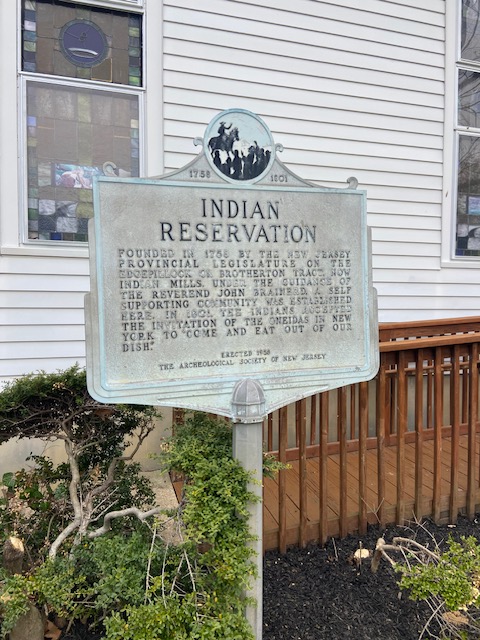
INDIAN RESERVATION 1758-1801
“Founded in 1758 by the New Jersey Provincial Legislature on the Edgepillock or Brotherton tract, now Indian Mills under the guidance of the Reverend John Brainerd. A self-supporting community was established here. In 1801 the Indians accepted the invitation of the Oneidas in New York to ‘Come eat out of our dish’
Original Indian sawmill and the Log meeting house, where John Brainerd preached to the Reservation Indians, was located near here. Later used by Whites for worship. Burned in 1809
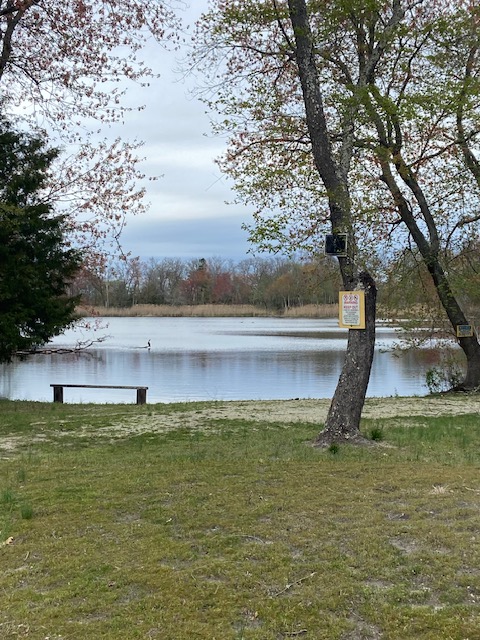
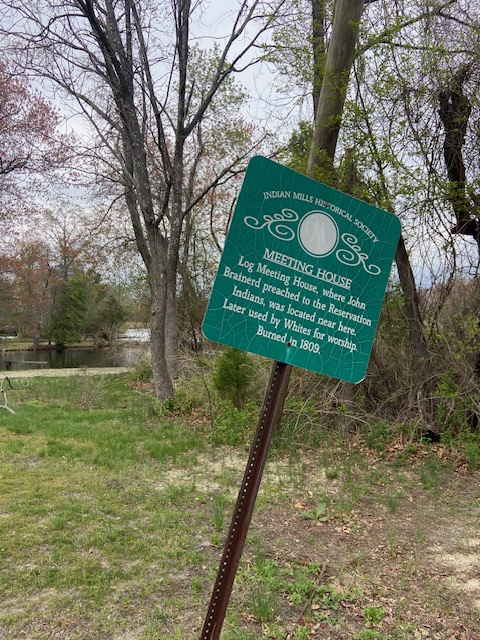
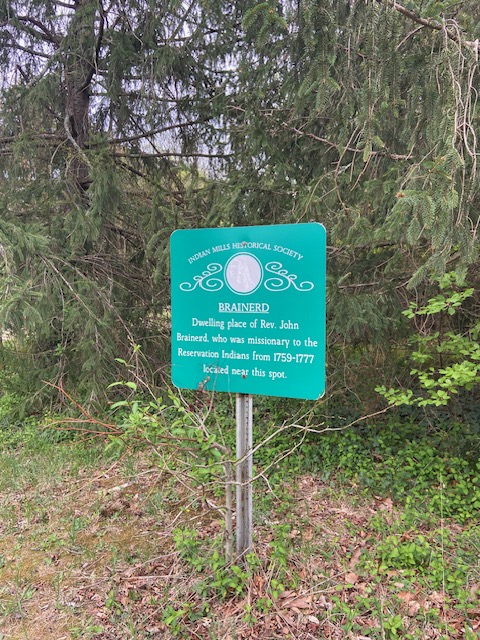
Alongside the creek and across from the site of the original Indian sawmill was John Brainerd’s home.
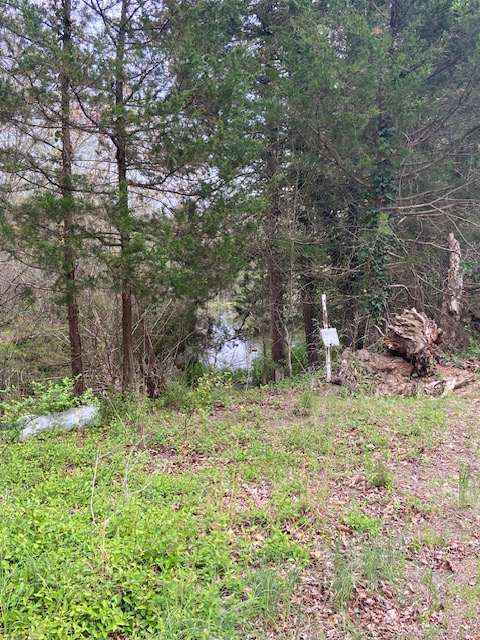
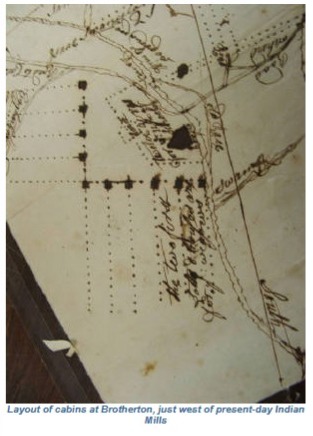
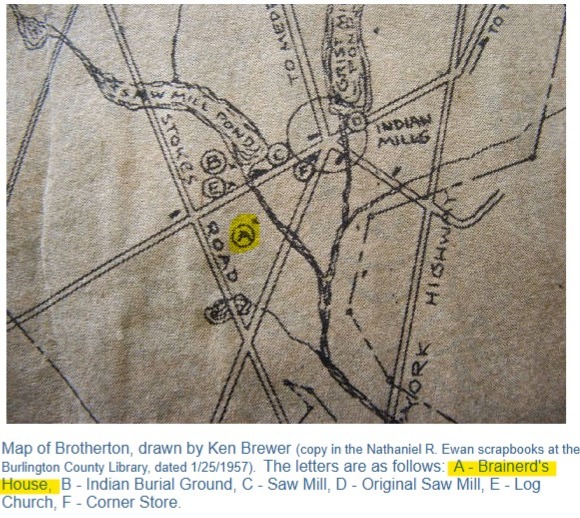
John left for Mt Holly until 1776. The Revolutionary War was fought in the town and he headed back to Brotherton until 1777.
After John left, the Indians had an offer in 1796 to join the Oneidas (originally from Stockbridge, MA) in New Stockbridge, NY. They declined initially but reconsidered a few years later, sold their land and moved north around 1802.
Mount Holly, NJ 1768-1776
As his hopes failed in regard to giving permanent character and prosperity to his Indian mission, he seems to have devoted himself entirely to founding churches among the scattered whites.
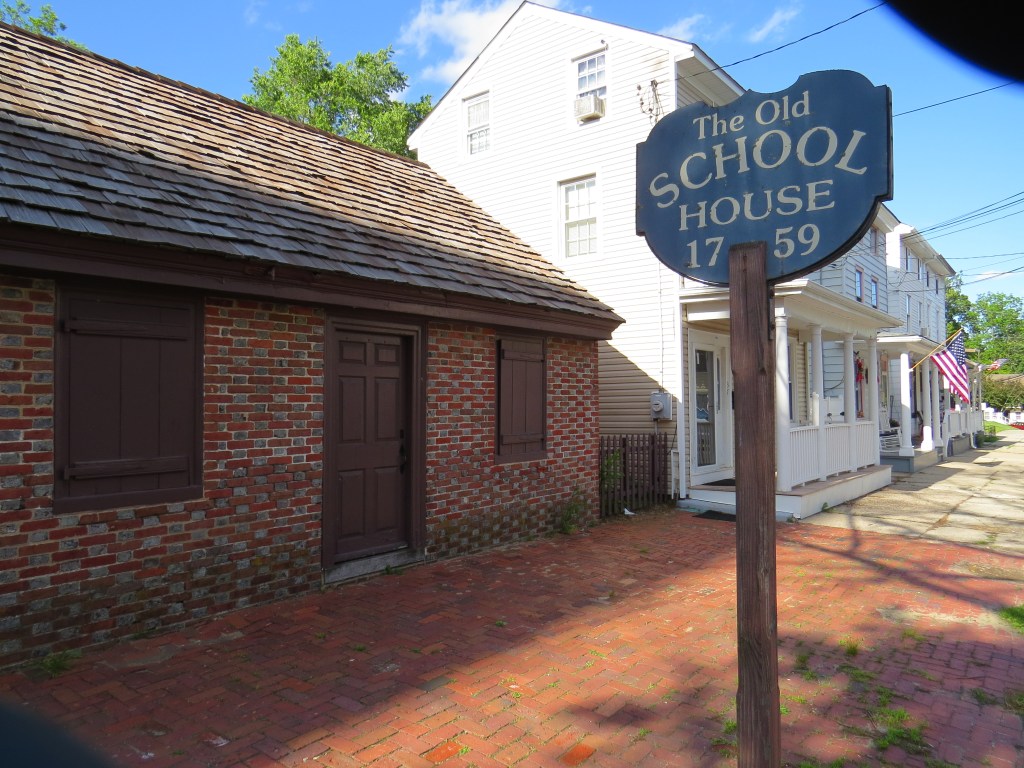
John took his wife and daughter and moved to Mount Holly, NJ. “He gathered a congregation and built a church, he purchased property near his church-edifice, and erected a dwelling and a schoolhouse.” The old schoolhouse in Mt Holly may be his original schoolhouse. It is debated, but worthy of consideration, having been built in 1759 and located between the lots he purchased for his church and his home.
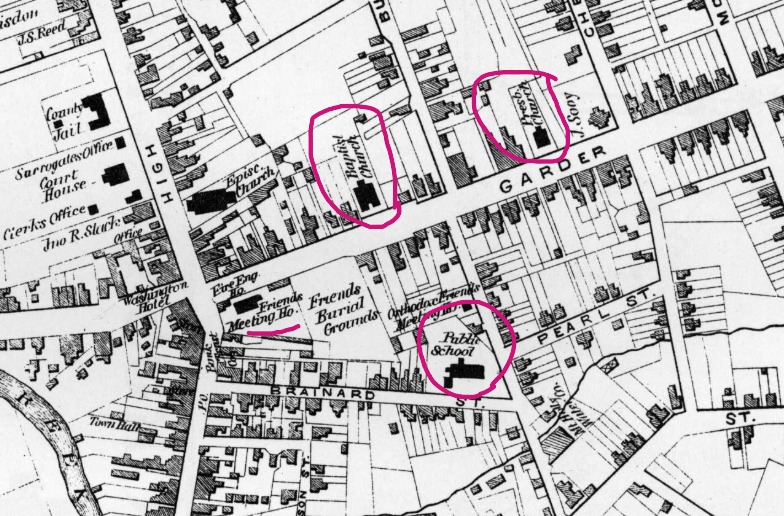
John left Brotherton in 1768 to begin a church in Mt. Holly, NJ. He remained, it seems, until the Revolutionary War. The British fought the Battle of Iron Works Hill in Dec of 1776. His church and home would have been on the same street as the occupied Quaker church on the map below.
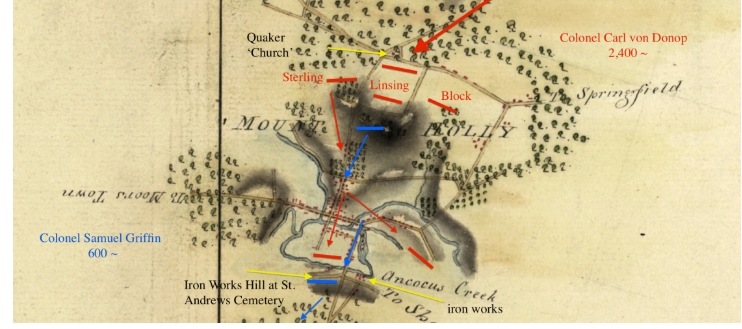
From 20th century Mt. Holly church brochures, it seems that his church was not destroyed until the British occupation of June 20-20, 1778. They passed through on their way to the Battle of Monmouth and proceeded to use his church as a stable and then burned it on their way out. The church was on the site of the current Methodist church property on Brainerd Street next to the old schoolhouse. His home was at the end of the street.
“We have little information of Mr. Brainerd’s labors during 1775 and 1776. It was a season of public turmoil. The battles of Lexington and Bunker Hill had been fought, the Declaration of Independence made, and the Presbyterian clergy of the country, sympathizing most heartily in the principles involved in the contest, were greatly engaged in stimulating the courage and animating the hopes of their fellow-countrymen…The motive which led Mr. Brainerd from Mount Holly to Brotherton, and from Brotherton finally to Deerfield, was, doubtless, to escape the agitations of the period, so that his influence as a minister of the gospel could be made still effective.”
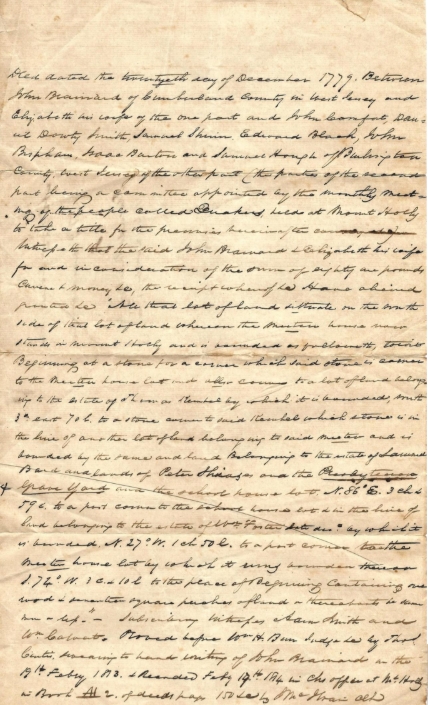
Deed selling his property in Mount Holly in 1779 to the Quakers
His daughter Mary, married Dr. John Ross of Mount Holly in 1779. John served in the Revolutionary War as of 1776. They had 4 children and she died at the age of 36. They are both buried in the St. Andrew’s cemetery in Mt. Holly.
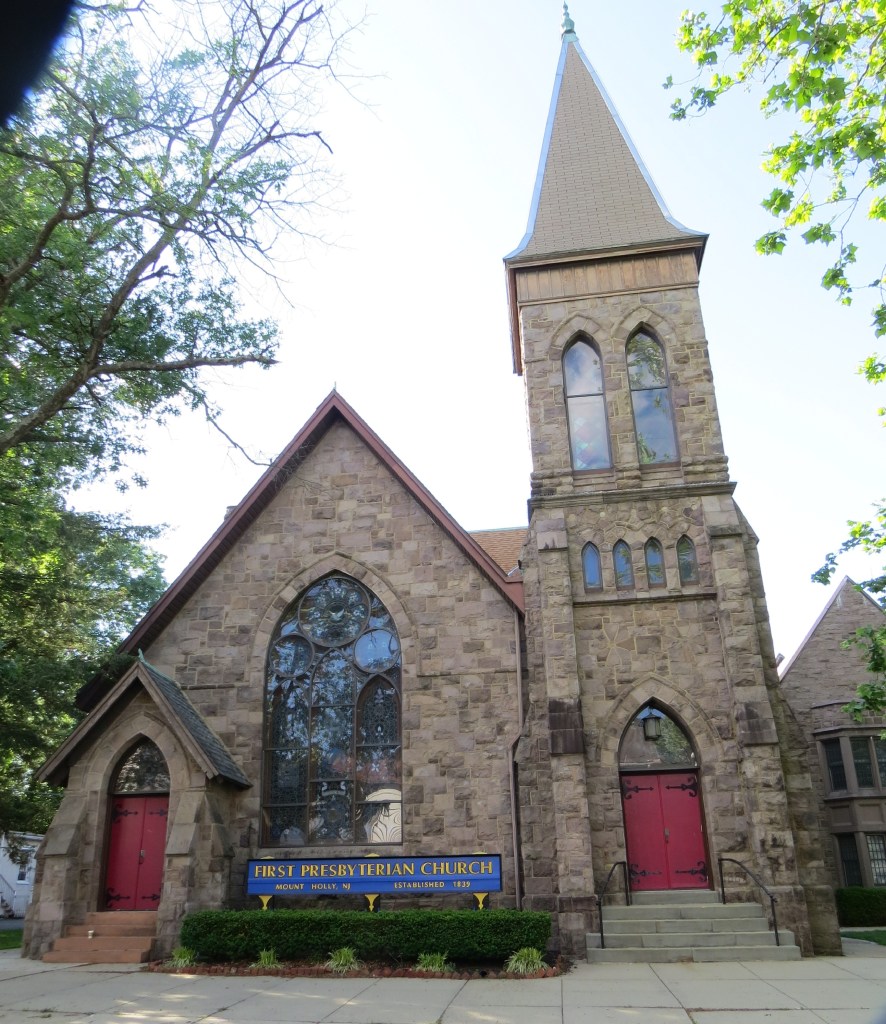
The Presbyterian church was revived in 1839 and Dr. Samuel Miller of Princeton University eventually became one of it’s pastors in 1845. And coming full circle, John’s relative, Thomas Brainerd, the author of The Life of John Brainerd, would also speak at the ceremony.
Deerfield, NJ – The Final Years 1777-1781
I give and recommend my soul into the hands of God in and through Jesus Christ, firmly relying on his name, merits, and righteousness for pardon, justification, and eternal life. The body I commit to the ground, to be decently interred only at the discretion of my executor hereinafter named, fully expecting to receive the same in the morning of the resurrection, glorified only through the rich grace of Jesus Christ.
John Brainerd Last Will and Testament
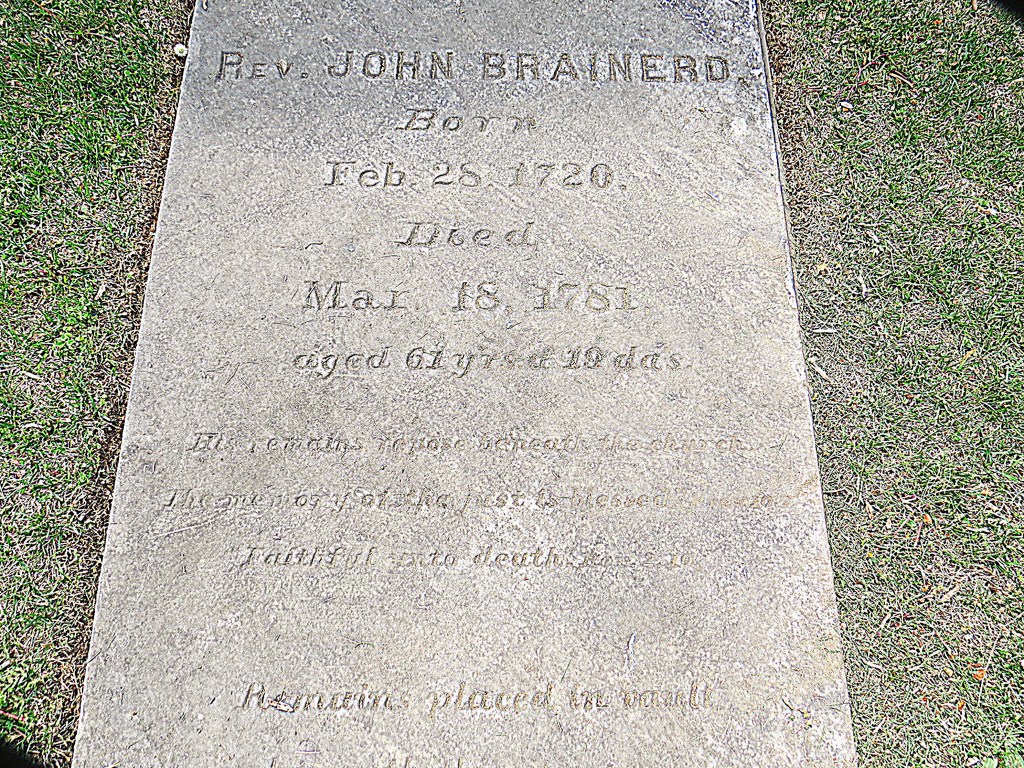
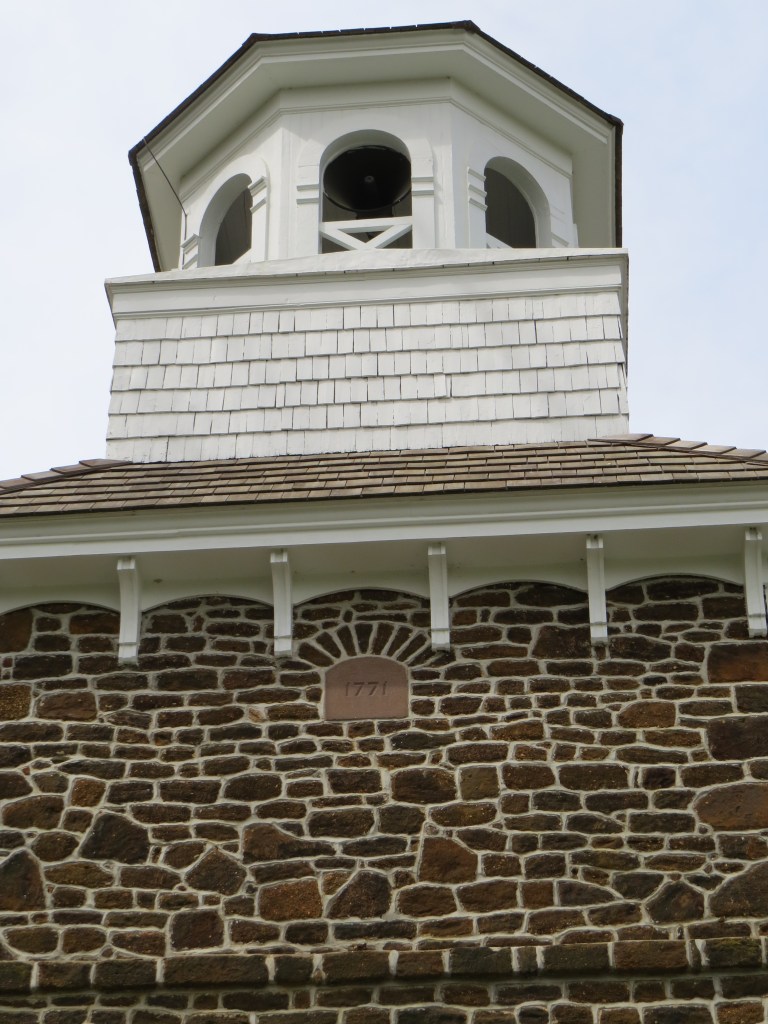
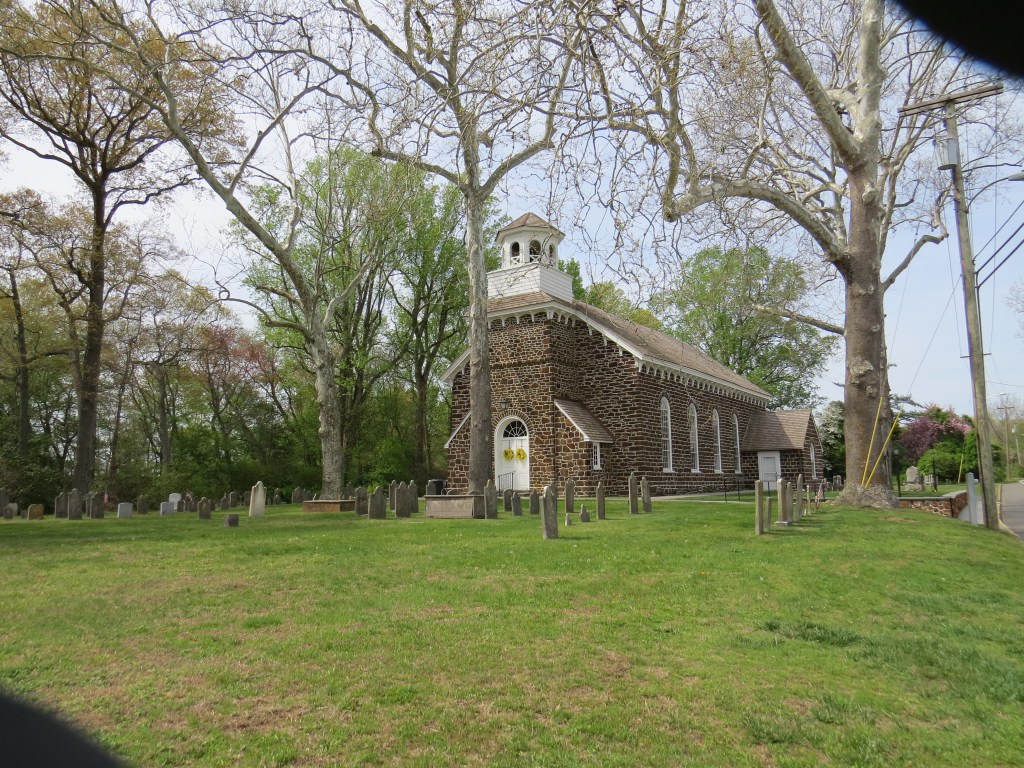
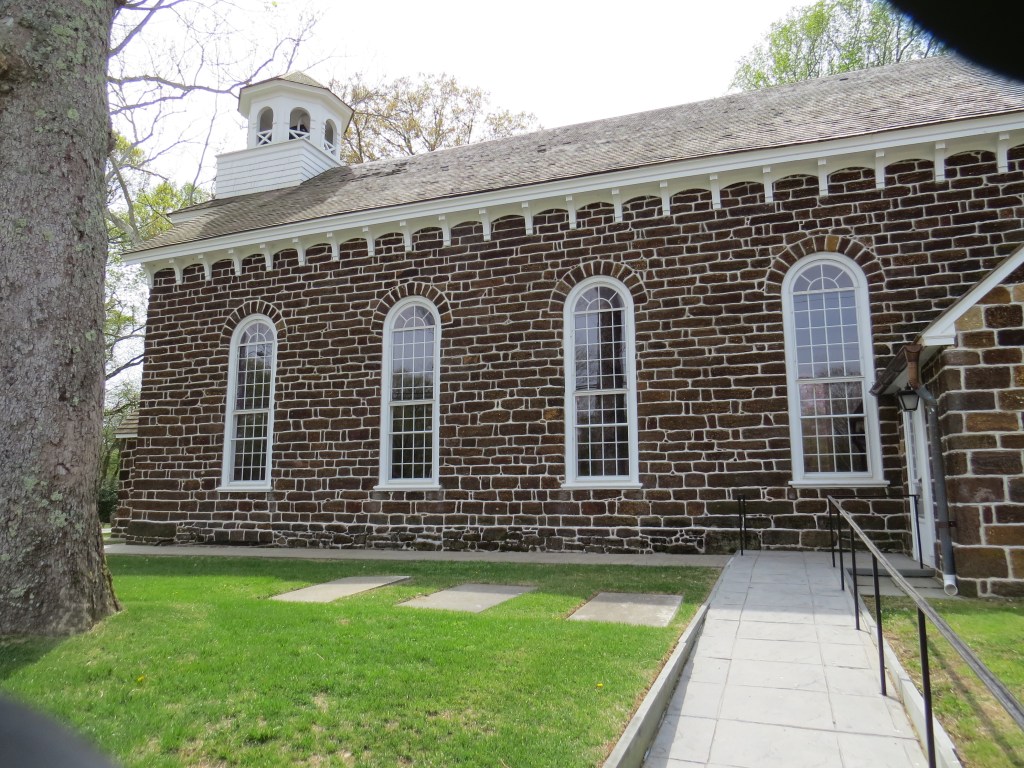
“In Deerfield, as in every other place where he labored, John Brainerd not only won the hearts of the people, but enstamped them with a holy influence. His ashes rest in the aisle of the same old church in which he preached the gospel at Deerfield. He died, aged sixty-one, in the dark, and stormy days of revolution and bloodshed. He was not permitted to see his country emerge from its perils and take a place among the nations of the earth. He died, remote from cities and crowds, in a quiet village and among plain people, and at a period when society, struggling for national life, took little account of the fate of individuals. No gazette heralded his departure, no orator gave him an eulogy, and no generous appreciation raised him a monument. For nearly seventy years his grave was unmarked even by a stone; but recently a friendly and generous hand has placed over his ashes a little slab, about twenty inches by thirty, on which are inscribed his name and the date of his death. He was of the number of Christ’s ” hidden ones.” His modesty led him to shrink from prominence in society ; his field of labor buried him for years in the forest. His death was in a secluded neighborhood; and the Church, for half a century, failed to mark even his grave.”
Princeton University Trustee 1754-1781
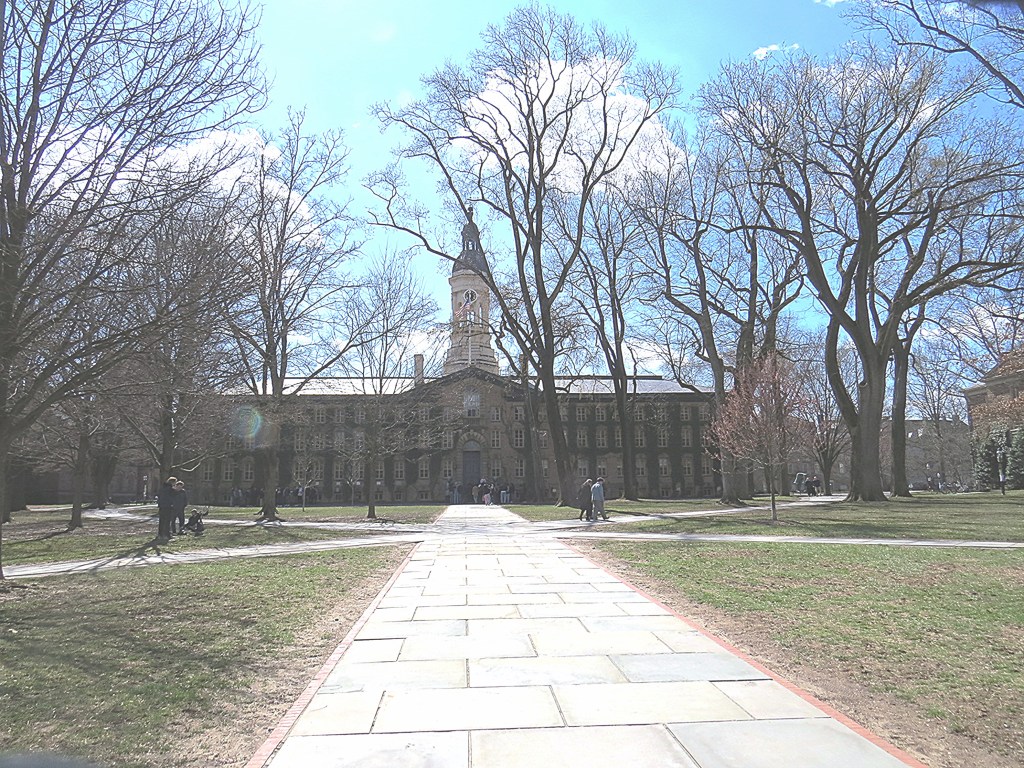
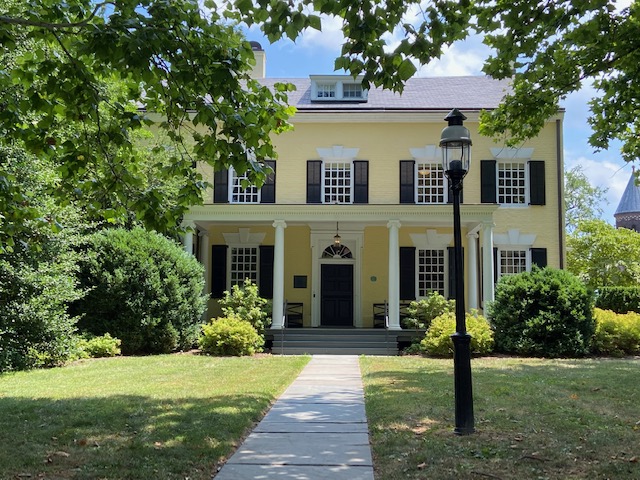
In the midst of all his ministry…John was asked to be a trustee of The College of New Jersey in 1754, its early days, and served 27 years faithfully in this role until his death in 1781. He was a leader there during the death of many presidents, including Aaron Burr Sr and Jonathan Edwards. He was part of the committee to build Nassau Hall and the President’s house, given the task of traveling to Stockbridge to secure Edwards in the role of president, he was present in meetings held during the days of the Revolutionary War and the Battle of Princeton.
 Beside Old Hearthstones - An American Evangelical Church History Tour
Leave a comment