a tour of Old Massachusetts
This post is a continuation of Part 1 and 2. Now we will cover Chapters 7-9 including John Eliot, Samuel Willard and Cotton Mather following along the excellent book titled The American Puritans by Nate Pickowicz and Dustin Benge.
Chapter 7 John Eliot 1604-1690
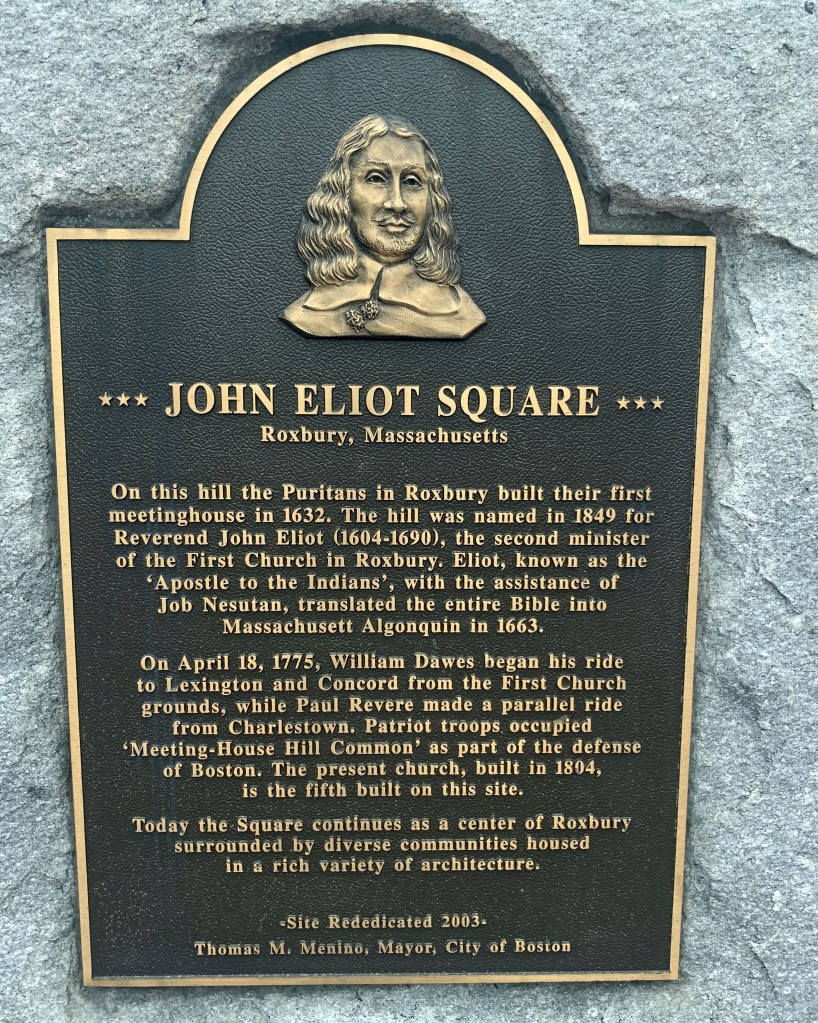
John Eliot arrived in Boston November 2, 1631, on the ship Lyon. As a minister, he was able to fill John Wilson’s pulpit of the Boston church while he was away in England. When this duty was complete, he settled in nearby Roxbury to join friends and family waiting for him to serve as their pastor. While in Roxbury, John began one of the first grammar schools in 1645 to teach colonial children and also the Indian and black children. In the future he would begin schools also to educated the Indians. He served 58 years in Roxbury as their pastor.
45 John Eliot Sq, Boston, MA
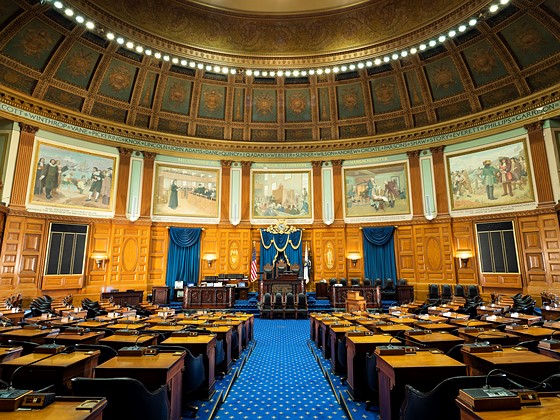
John began his ministry to the Indians in 1646. He had to learn the language to speak effectively and was able to print the first Bible in America in the Natick language. “In 1646, the Massachusetts General Court passed the Act for the Propagation of the Gospel amongst the Indian” (pg 153) This ministry would continue for the remainder of his days. He would begin laying the foundations of “praying towns”, Christian communities for the Indians seeking land grants for this purpose. Natick would be the first, followed by Punkapoag and Hassanamesit. In all there would be 14. Sadly, King Philips War of 1675-1678 would devastate these towns. A mural of Eliot can be seen today in the Massachusetts State House.
24 Beacon St, Boston, MA
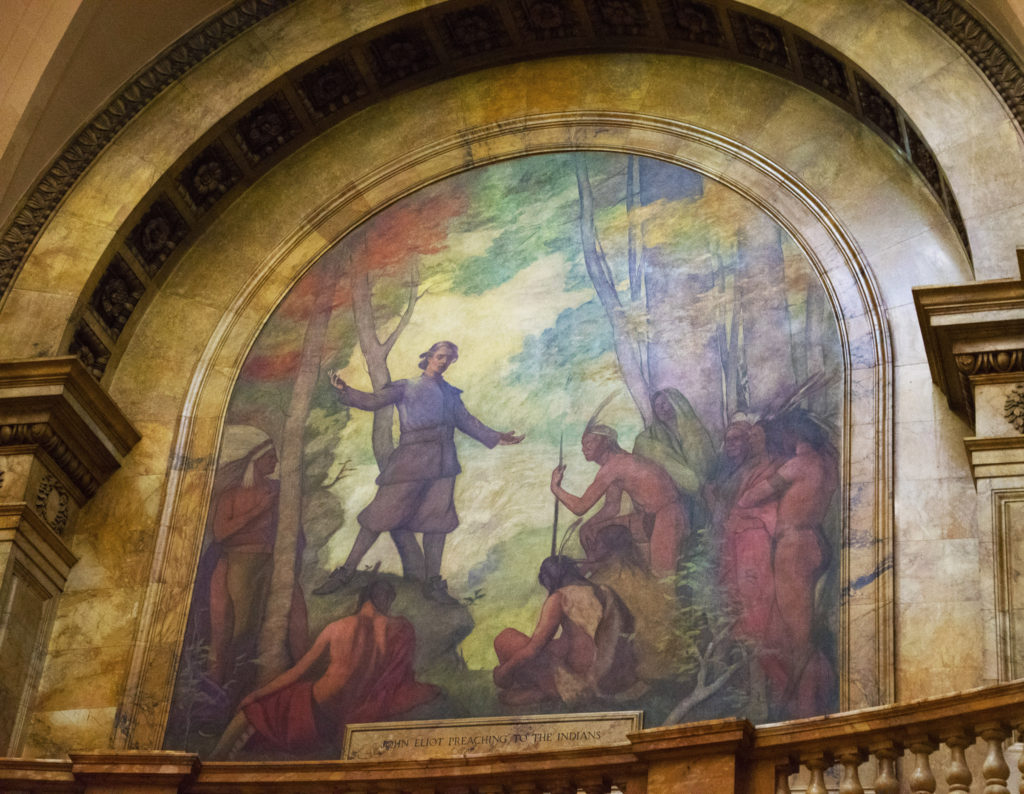
By Henry Oliver Walker, 1903
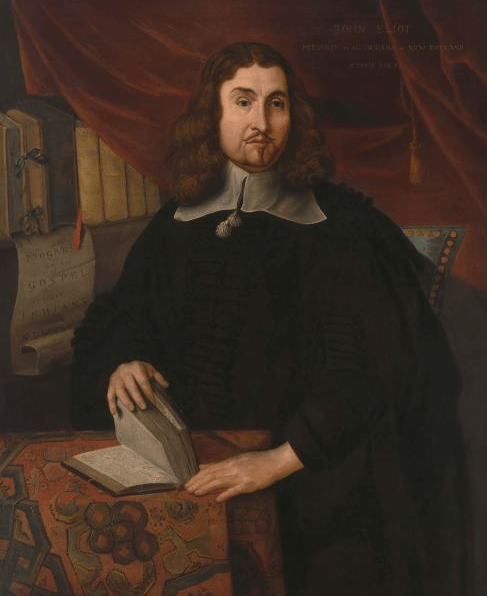
The Eliot Indian College and Bible
source
John Eliot’s single-handed translation of the Bible into the Natick dialect of the Massachuset language was the first printed Bible in North America, and the largest single printing project of the colonial era…Samuel Green and Marmaduke Johnson produced a first edition of one thousand copies of the complete Bible, of which just a few dozen remain in existence. Most copies of Eliot’s 1663 Bible were destroyed during King Philip’s War in 1675-1676, but a second, improved, edition was published in 1685.
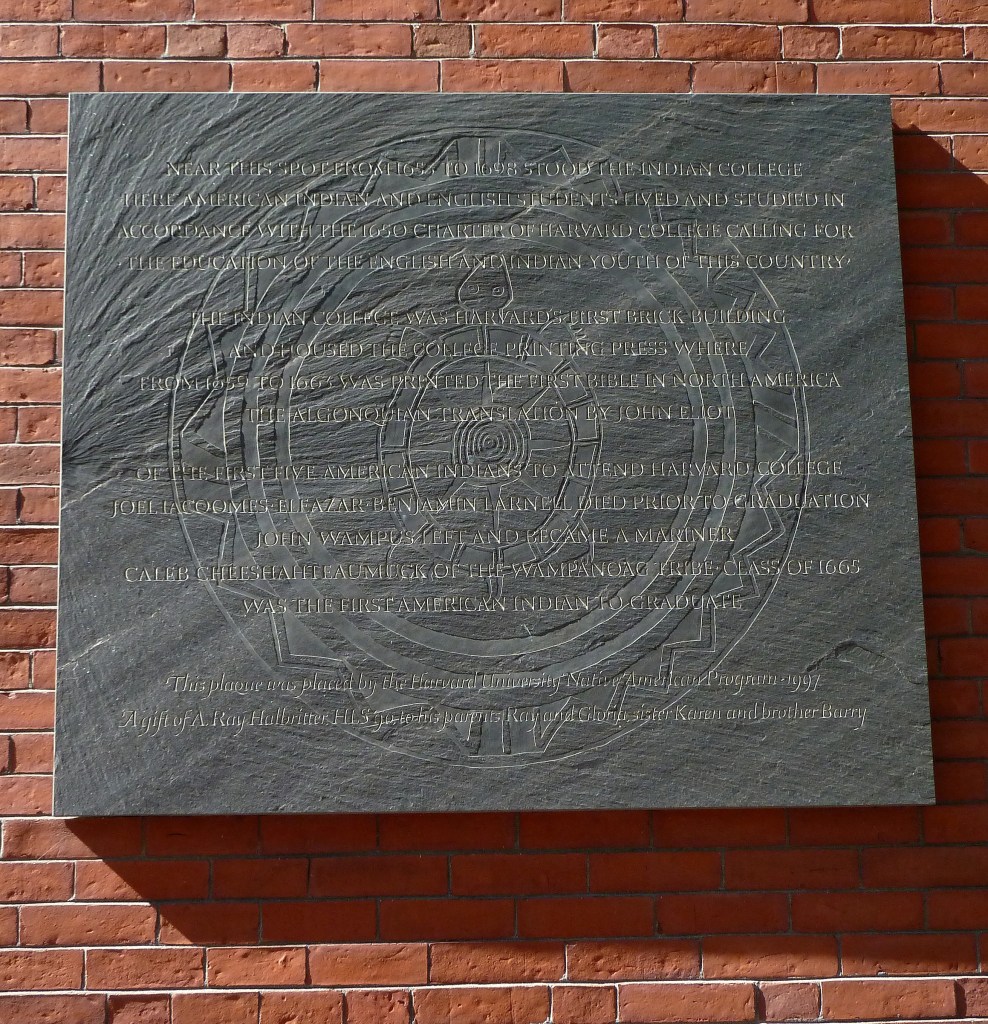
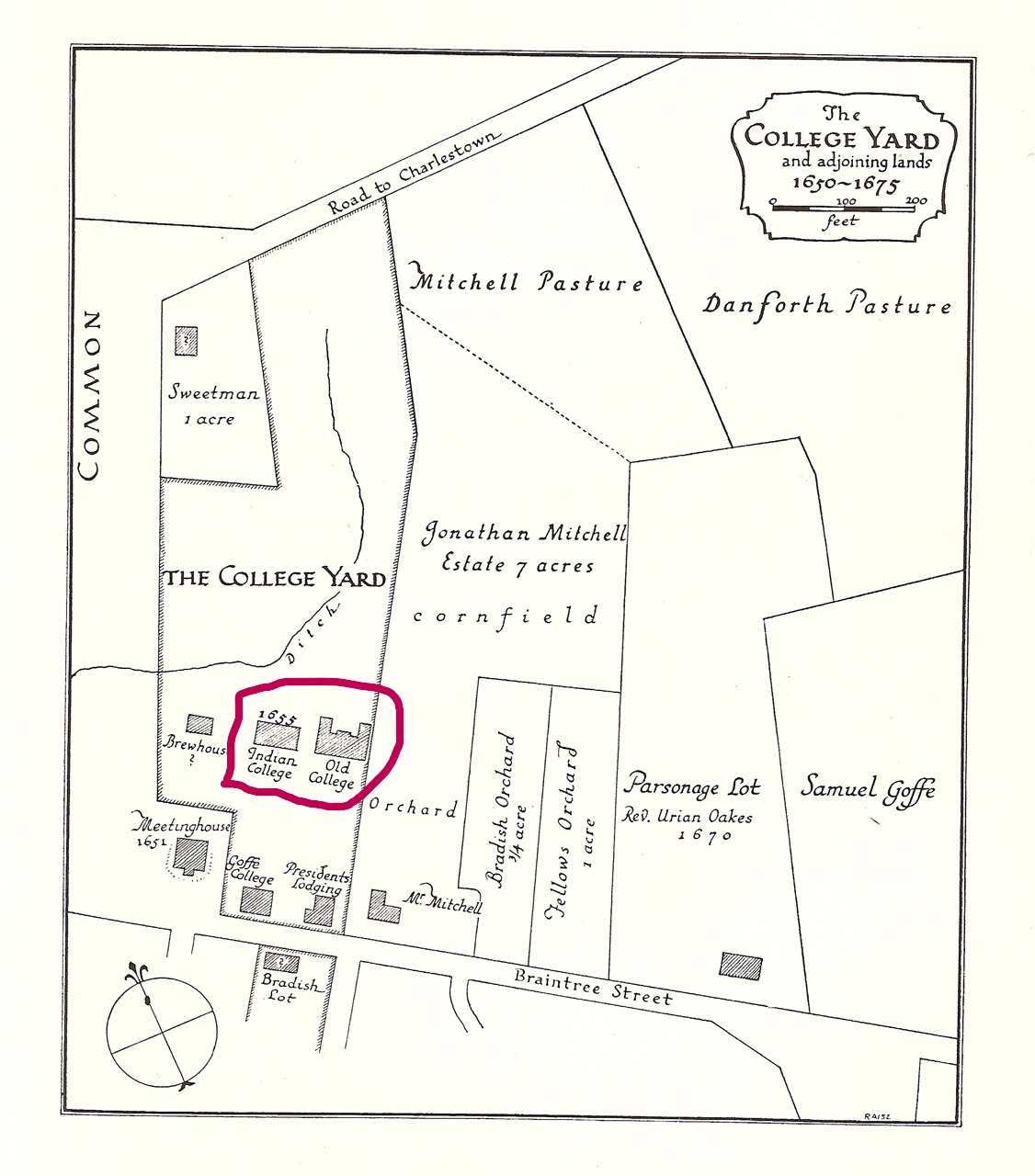
John also helped establish the Indian College. “The Indian College’s building, located in Harvard Yard, was completed in 1656. It housed a printing press used to publish the first Christian Bible translated into a Native American language, the Eliot Indian Bible of 1663, which was also the first Bible in any language printed in British America.” source The college and printing press were located where Matthews Hall sits today. A plaque on the building commemorates the college. The inscription reads:
“Near this spot from 1655 to 1698 stood the Indian College. Here American Indian and English students lived and studied in accordance with the 1650 charter of Harvard College calling for the education of the English and Indian youth of this country.
The Indian College was Harvard’s first brick building and housed the college printing press where from 1659 to 1663 was printed the first Bible in North America, the Algonquian translation by John Eliot.
Of the first five American Indians to attend Harvard College, Joel Iacoomes, Eleazar, Benjamin Larnell died prior to graduation, John Wampus left and became a mariner, Caleb Cheeshahteaumuck of the Wampanoag tribe, class of 1665, was the first American Indian to graduate. source
Matthews Hall, Cambridge

“Eliot was the only missionary to devise a new alphabet from an unwritten language for the purpose of teaching and preaching Scriptures” (pg 156)
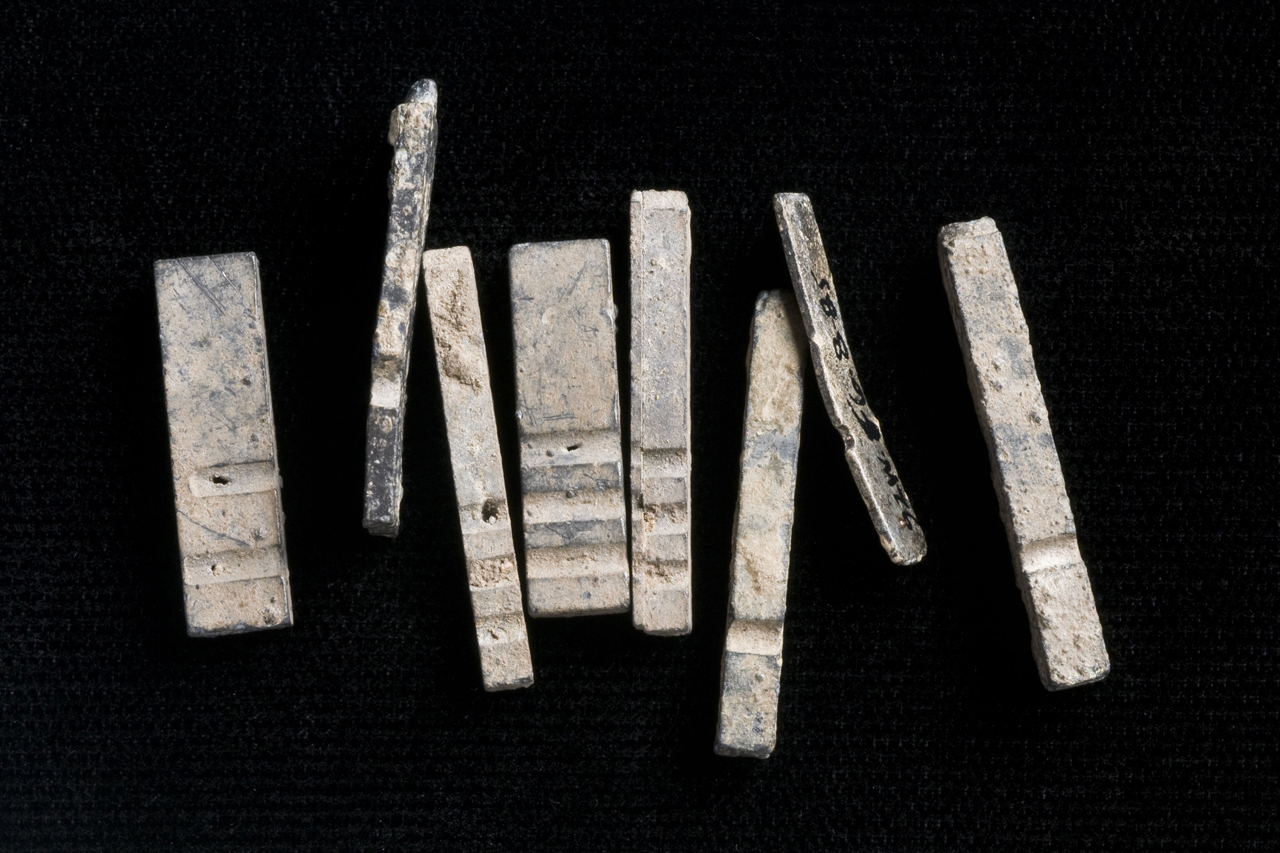
Harvard University began an archaeological dig in 2005 searching for the original Indian College of John Eliot’s Day. They found lead printing type of the early printing press he used to print the first Bible printed in the New World. “The most intriguing objects found in the Harvard Yard excavations were pieces of lead printing type dating back to the 17th century. At first glance, these lead alloy bars may not impress, but they are small pieces of an important story. Each bears the mold of a single letter. When arranged in rows, coated with thick ink, and pressed onto paper, they created the first books printed in North America. The fonts, or particular shapes, of some of these letters have been matched to surviving 17th-century products of Harvard’s early press.” source
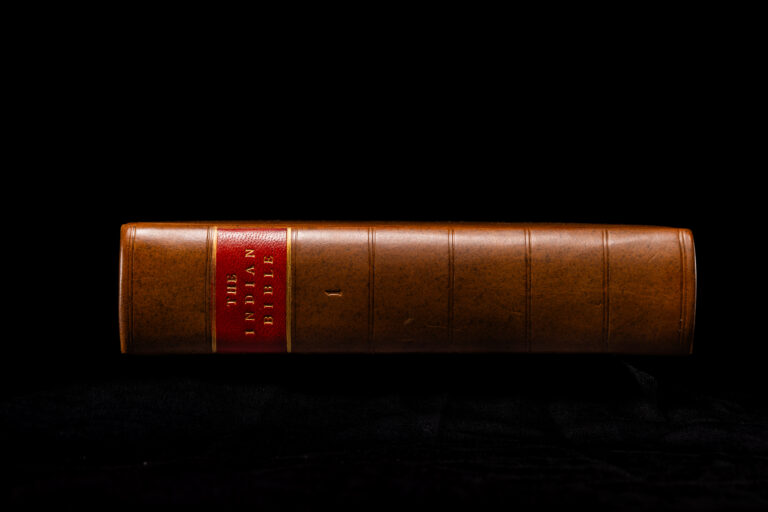
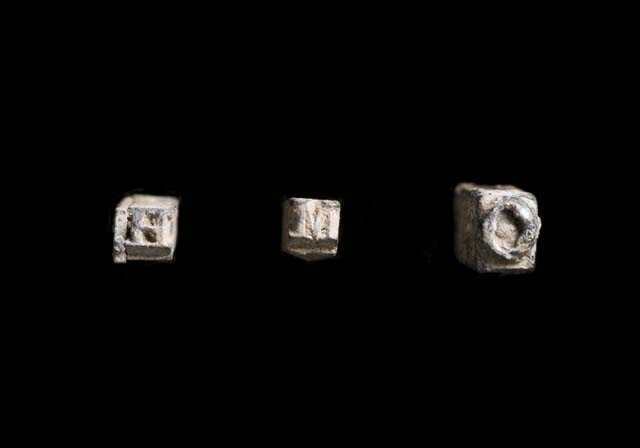
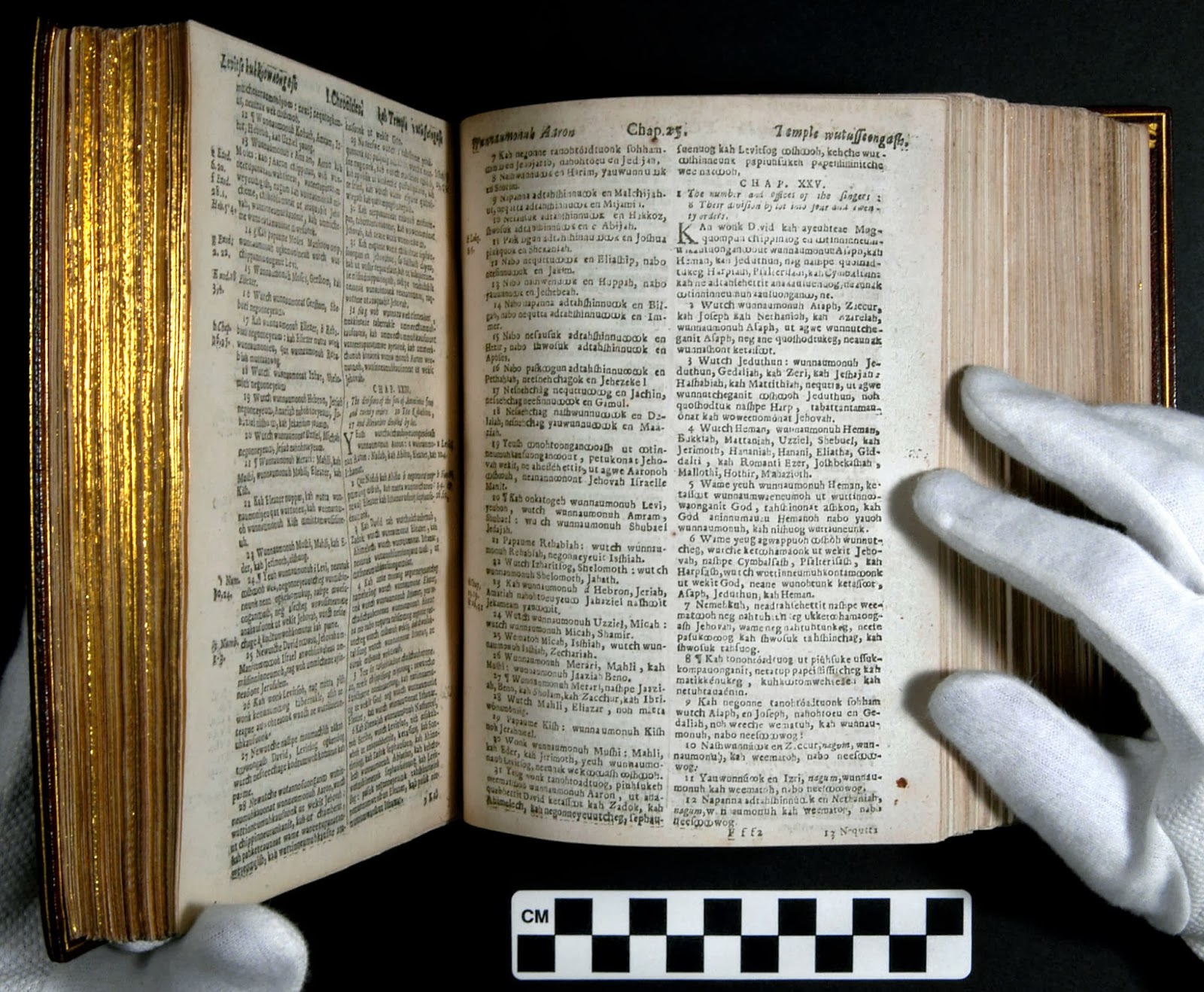
First Edition Eliot Bible, New and Old Testament, 1663. A 1685 second edition can be viewed at Yale.
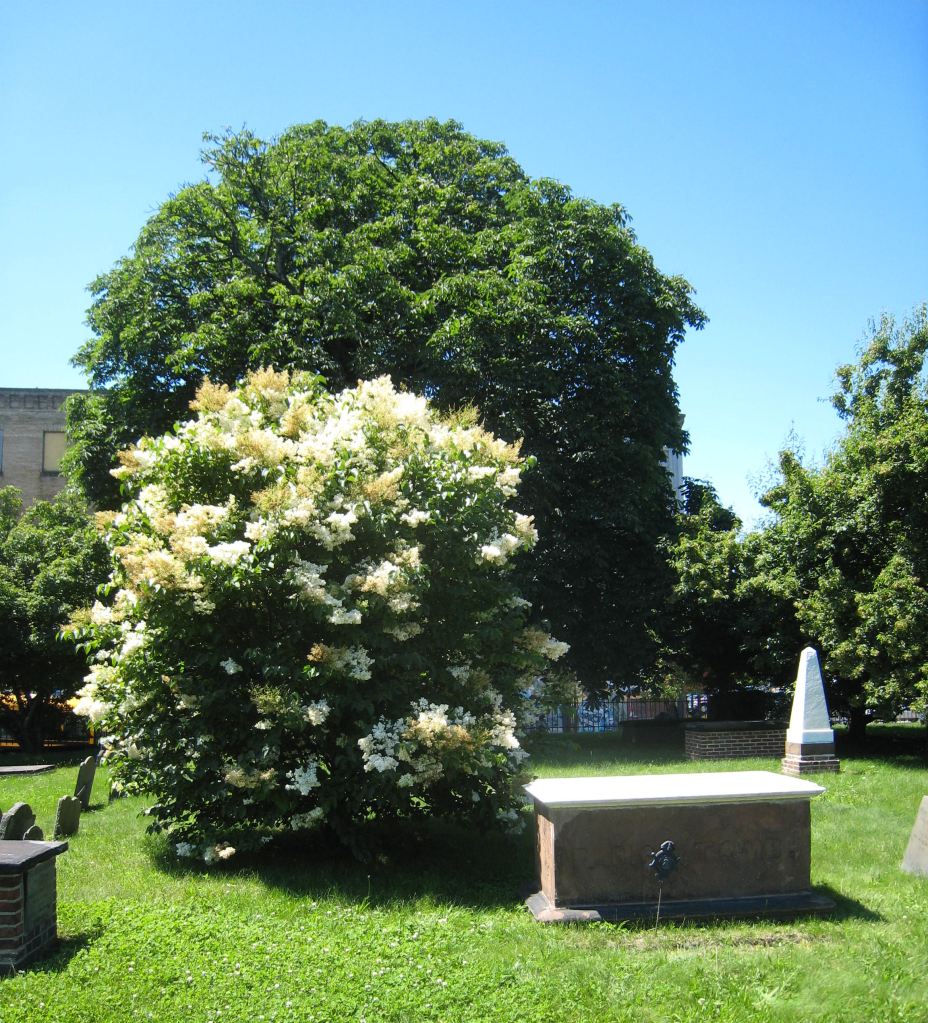
Eliot married Hannah Mumford in October of 1632. “Tradition insists that she graced her home with a spirit of hospitality…she served as a dutiful mother of the six children born into the Eliot home.” (pg 148) John died in 1690 and is buried in Roxbury, MA at the Eliot Burying Ground.
20 Eustis St, Roxbury, MA
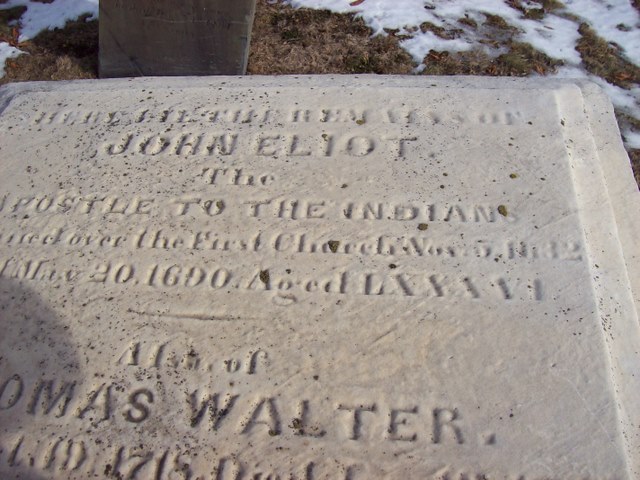
John Eliot was a very simple man: simple in his acceptance of Scripture as the Word of God, simple in his trust that God saves all who call on the name of Christ, simple in his endeavors to establish a Christian society among the Indians, and simple in his belief that all men and women are in need of the saving gospel message.
American Puritans, pg 162
Chapter 8 Samuel Willard 1640-1707
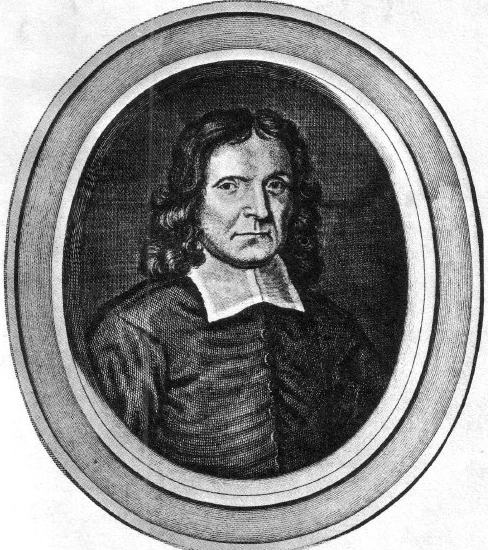
Samuel Willard was part of the second generation of pilgrims. His father, Simon, and first wife crossed the ocean in April 1634 ultimately settling in Concord in Sept 1635. Samuel was born to Simon and his third wife, Mary Dunster.
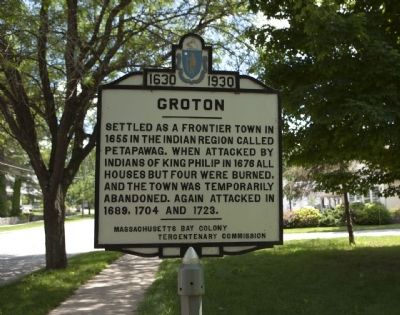
He entered Harvard College in 1655 and at age 23. In 1663 he began to preach in Groton, MA, 35 miles north of Boston. Unfortunately, in 1676, 400 Indians would attack Groton as part of King Phillips War. They burned the town and its meetinghouse. Several were killed including his father.
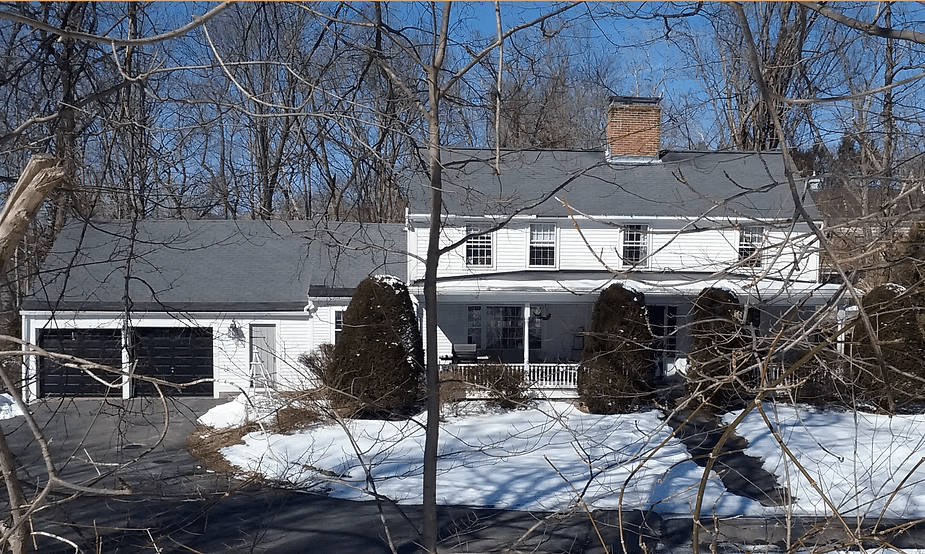
Rev. Samuel Willard Garrison House remains today
It may be that early church meetings were held in this house, as the town was without a church building until 1666. The house was built as a garrison house, to shelter and defend a neighborhood in an attack in a time when Groton was a frontier town. “Like an ordinary house in plan and appearance, garrisons were used in times of peace as one-family dwellings, but were strongly built and capable of protecting a number of families in times of danger.” Willard’s garrison house is entirely lined with brick. source
153 Main Street Groton, MA
In 1676, he left Groton and moved to Boston to pastor Third Church for 21 years.
In 1692 the Salem witch hysteria began and Willard was named in the accusations. He said caution was warranted but, his counsel was disregarded by the courts. Earlier in Groton the town was taken with idea of witchcraft, Willard cautioned to use discernment then as well. He used Scripture and prayer to deal with demonically afflicted girl and thus staved off hysteria.
Judge Samuel Sewall a member of Willard’s congregation presided over the trials and eventually issued a confession which Willard read to the congregation. The confession in part read:
Samuel Sewall, sensible of the reiterated strokes of God upon himself and family; and being sensible, that as to the Guilt contracted … Asking pardon of men, And especially desiring prayers that God, who has an Unlimited Authority, would pardon that sin and all other his sins; personal and Relative…
“In 1697, Judge Samuel Sewall stood before the congregation at South Church while his minister, Rev. Willard, read Sewall’s apology for his part in the witch trials. Sewall is the only judge known to have apologized publicly. A mural depicting this event is displayed in the House Chamber of the Boston State House today. It was painted by Albert Herter in 1942.” source
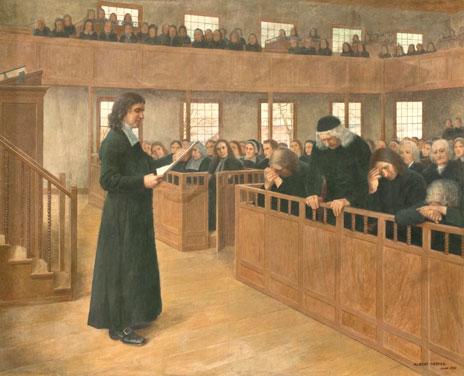
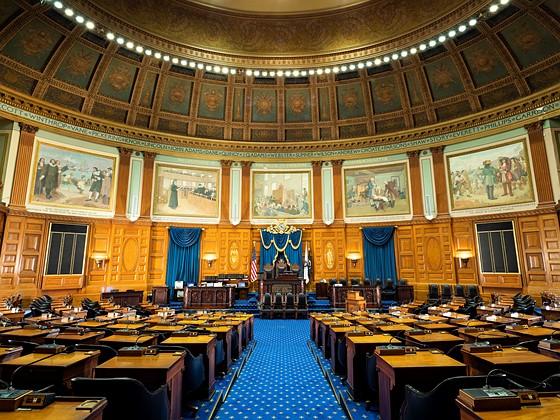
Interestingly, Ben Franklin born in 1706 was baptized at the church while Willard was pastor, he very likley baptized him. Baptismal records, 1669-1875, Old South Church in Boston, Mass pg. 74

Thomas Prince would also famously pastor this congregation from 1730-1758.
In addition to his pastoral duties, Samuel was vice president of Harvard, he battled Arminianism and controversy over the Halfway Covenant. In the end Willard was remembered this way,
“Willard’s whole ministry jealously guarded the honor of sovereign grace.” (pg 180)
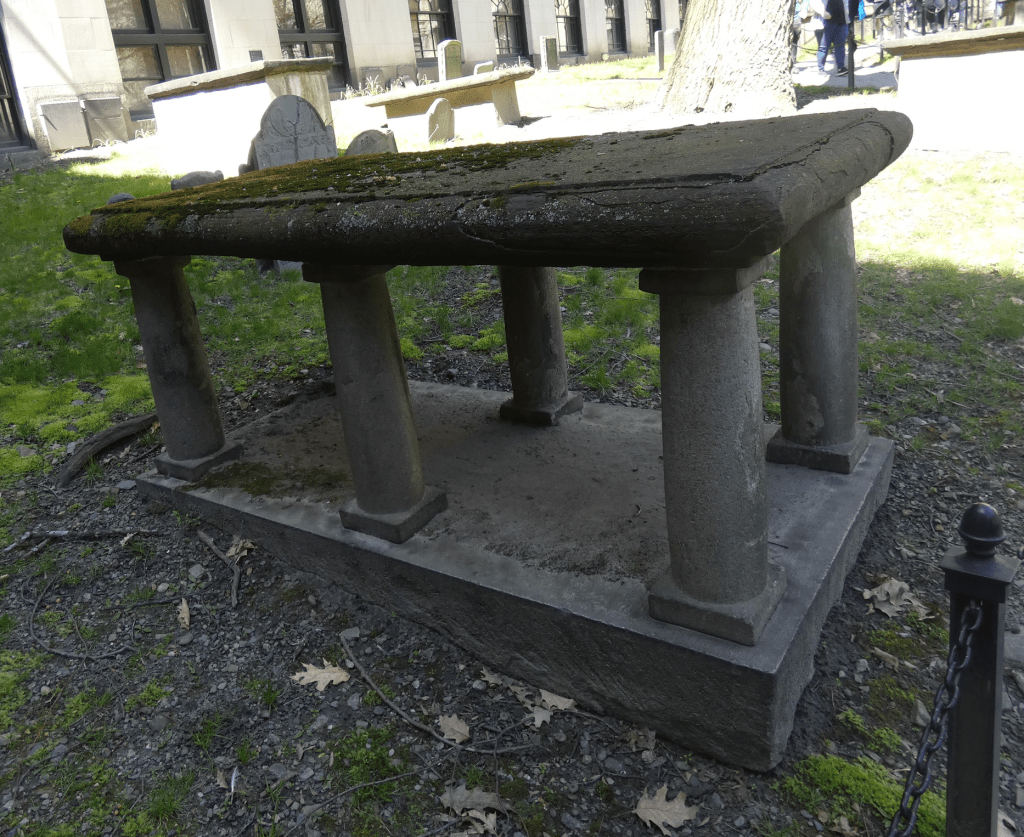
He died in 1707 and was buried in Granary Burying Ground in Boston.
Tremont St, Boston, MA
Chapter 9 Cotton Mather 1663-1723
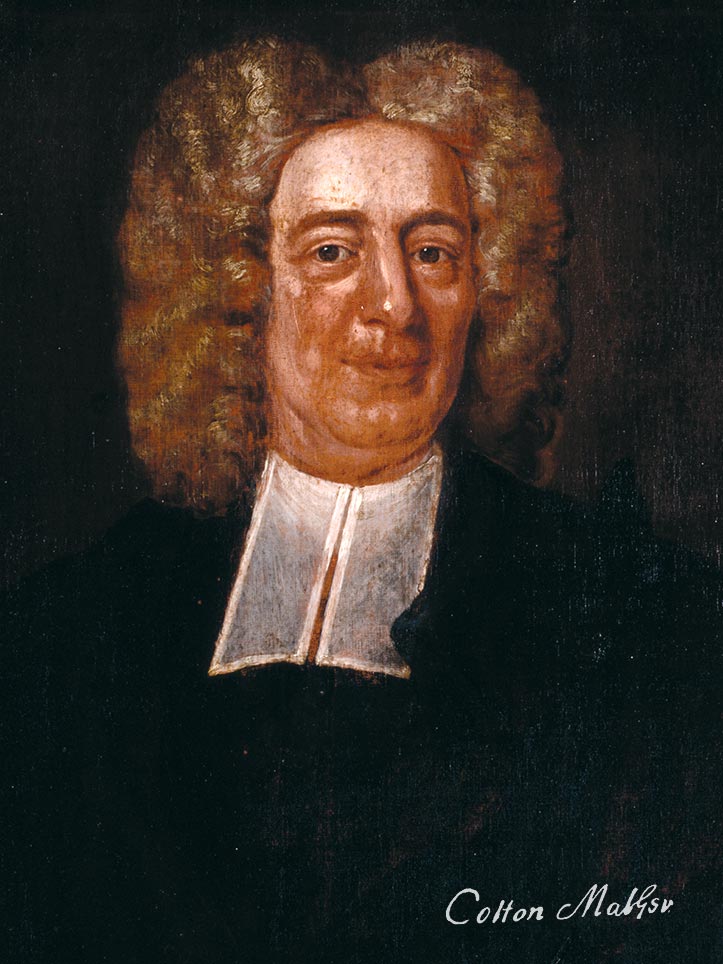
Cotton’s grandfather was Richard Mather (1596-1669), a nonconformist pastor in England who came to New England in 1635. His first wife died after giving him six sons. Richard’s second wife, Sarah, was the widow of John Cotton (also our subject’s grandfather and namesake). She gave birth to Cotton’s father Increase in 1639.
Increase then married Maria Cotton, daughter of John Cotton (from his first marriage!). Getting confused?!
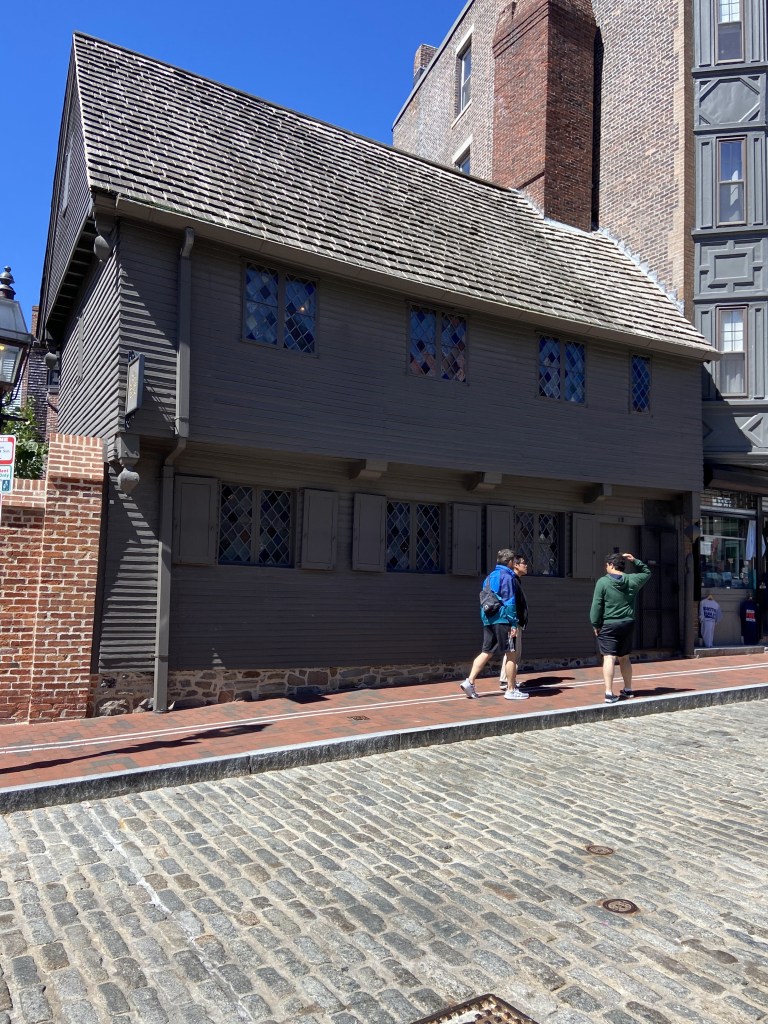
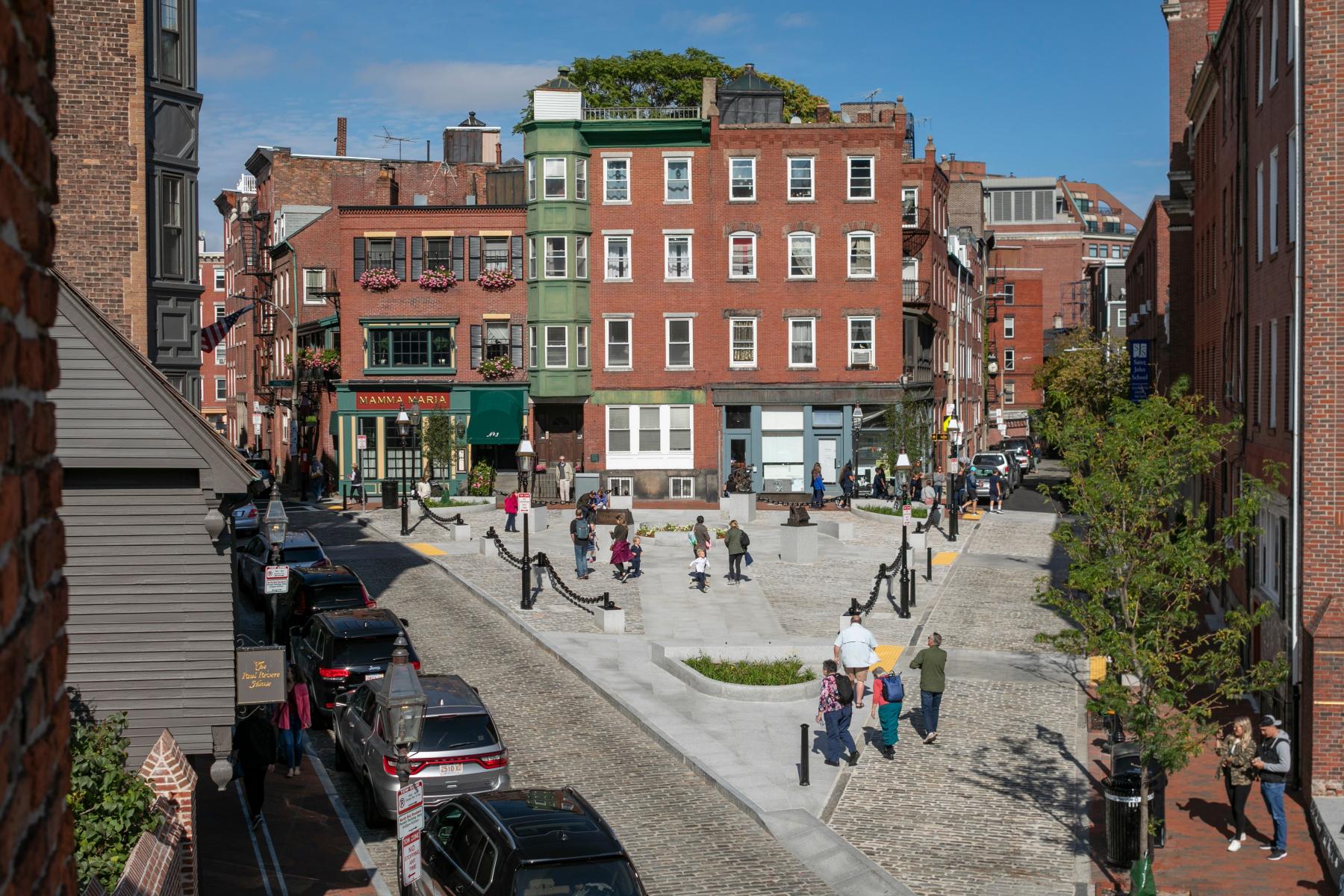
The Mather family home was located on the site of Paul Revere’s house. The home was built in 1670 and destroyed in the Great Fire of 1676. The family moved to Hanover Street the next year.
19 N Square, Boston, MA
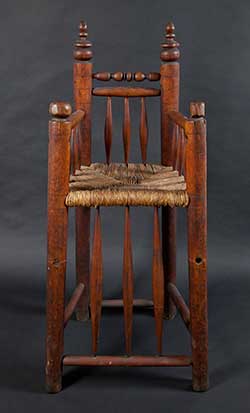
Mather family highchair
One of the few remaining artifacts of the Mathers. “If it was purchased by Richard and Catherine Mather following their arrival in Massachusetts in 1635 for their sons Eleazer or Increase, then it was likely made in Dorchester where Richard had accepted the ministry of the North Church. If it was commissioned by Increase and Maria Mather when their son Cotton was born in 1663, then it was probably made in Boston, where Increase was minster of Boston’s North Church from 1664 to 1723. source
185 Salisbury St, Worcester, MA
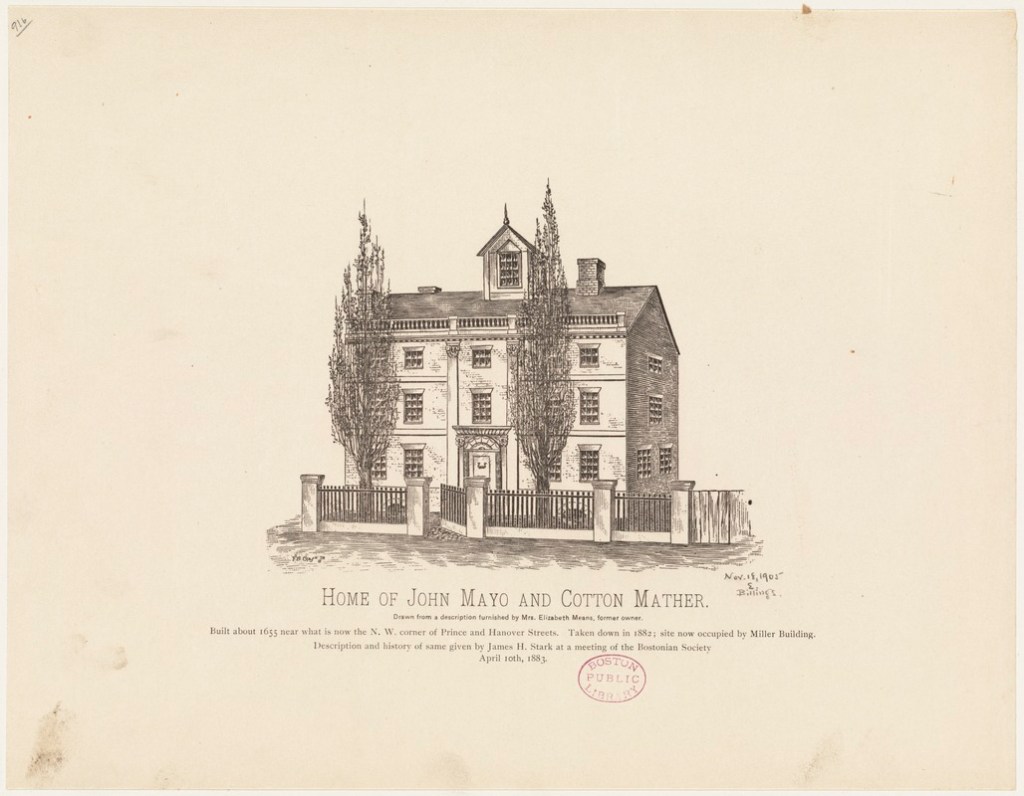
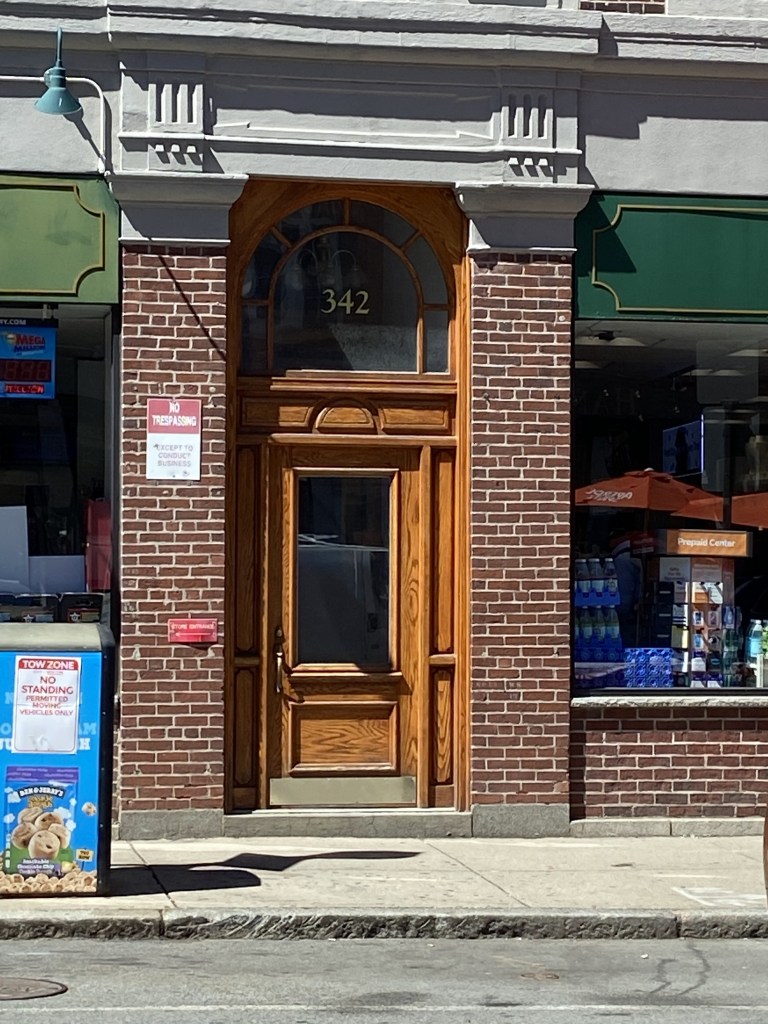
342 Hanover St, Boston
The original doorway remains.
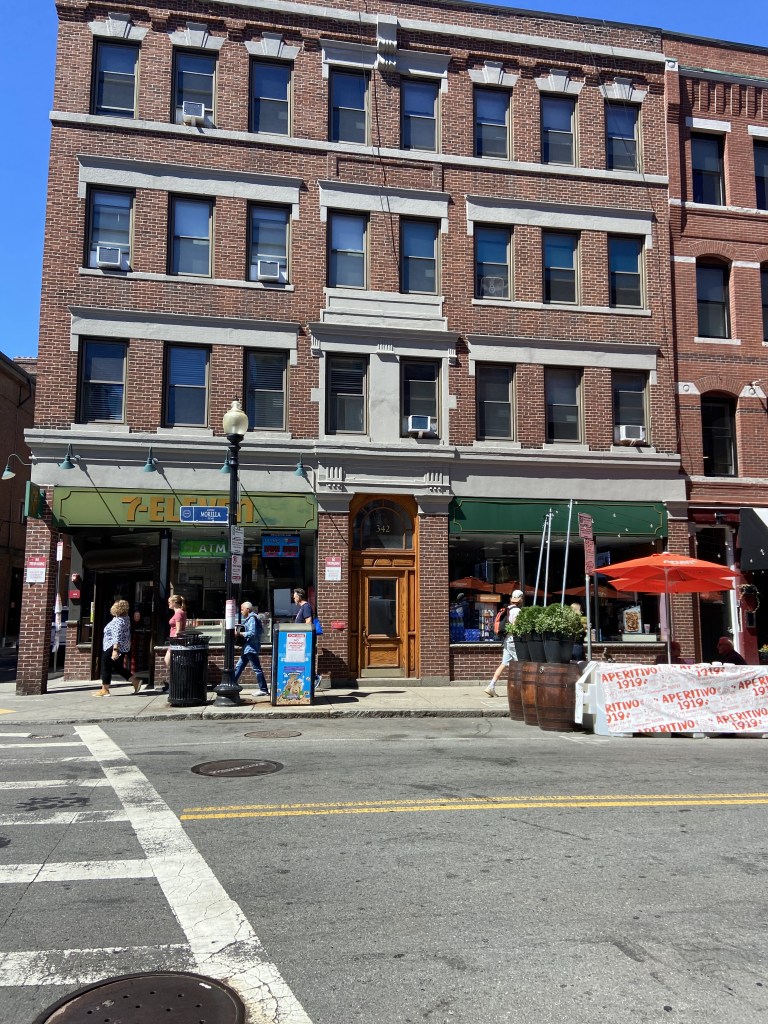
Increase was the pastor of Second Church in Boston and served there 60 years until his death in 1723. Cotton was born in 1663 and followed in his father’s footsteps serving alongside him at Second beginning in 1681 after attending Harvard.
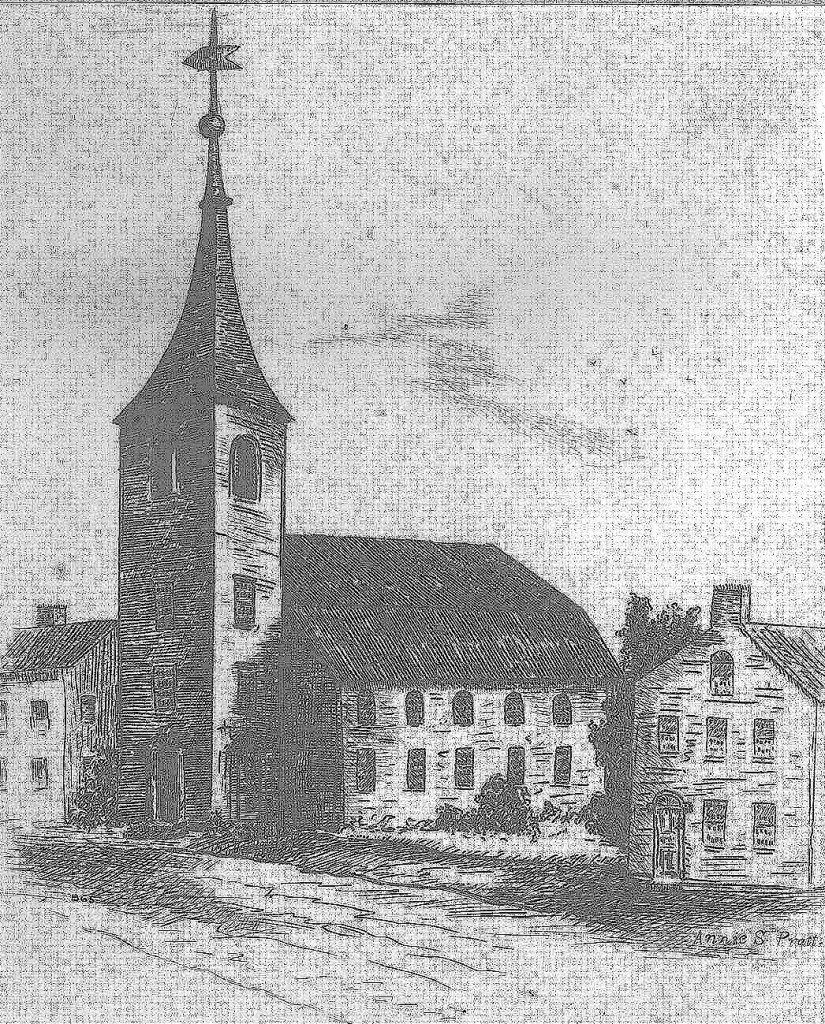
“Second Church, also known as the “Church of the Mathers”, was founded in 1649 when Boston’s population spread to the North End and justified an additional congregation sited closer to those individuals’ homes. From 1664 to 1741, its clergy consisted of Increase Mather, Cotton Mather, and Samuel Mather…The original building was destroyed by fire in 1676;a replacement was built in 1677. The newer “Old North Meeting House” was destroyed by the British army in 1776.” source
Cotton was involved giving counsel during the Salem Witch Trials. He advised prayer and pastoral care, which was ignored and ultimately 20 people were killed.
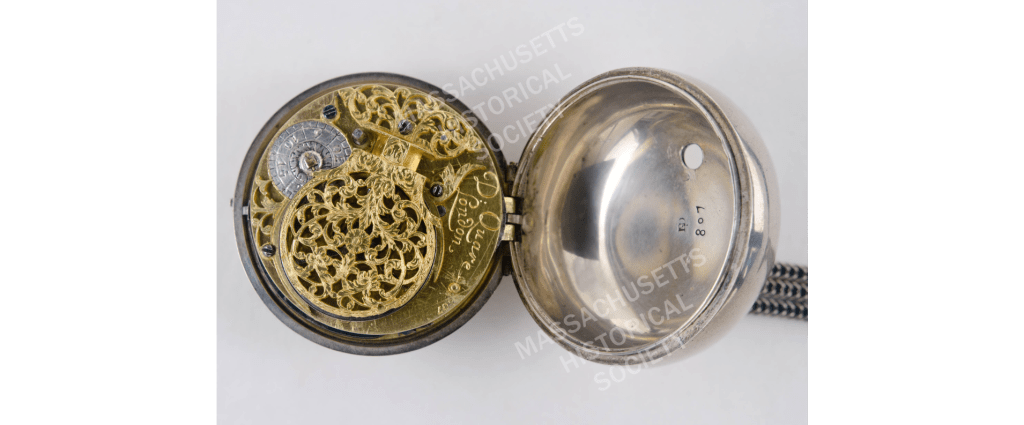
Mather was an avid reader and his books are in the Mather Family library located at the American Antiquarian Society (as is the high chair) in Worcester MA. He also wrote 469 published works in addition to a 4500 page Bible commentary. The only other object left, that I have found, is Cotton’s pocket watch. This can be seen with an appointment at the Massachusetts Historical Society.
1154 Boylston St, Boston, MA
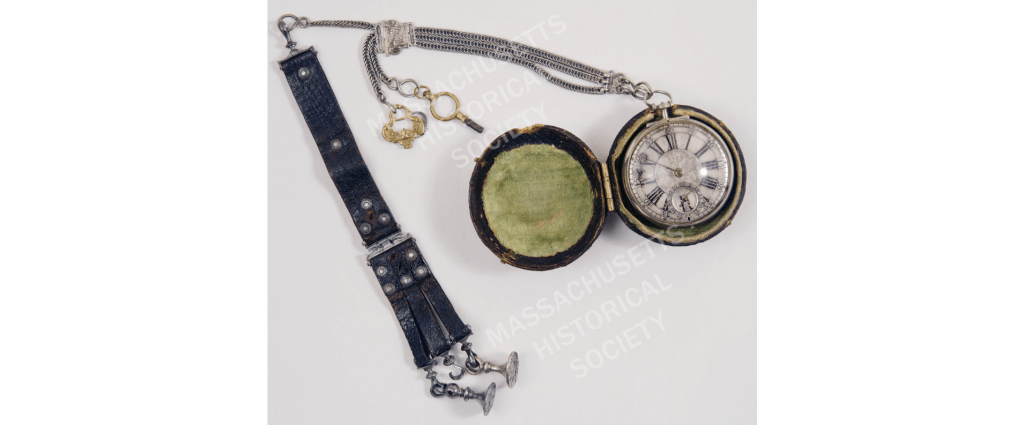
Silver, enamel, gold, crystal by by Daniel Quare. England, 1680 “This watch, made by master clockmaker Daniel Quare of London, belonged to the Puritan clergyman Cotton Mather. According to family tradition, it was “carried by him among the Indians, who, hearing the ticking, were frightened and thought he carried the Devil in his pocket, and ran away from him.” source
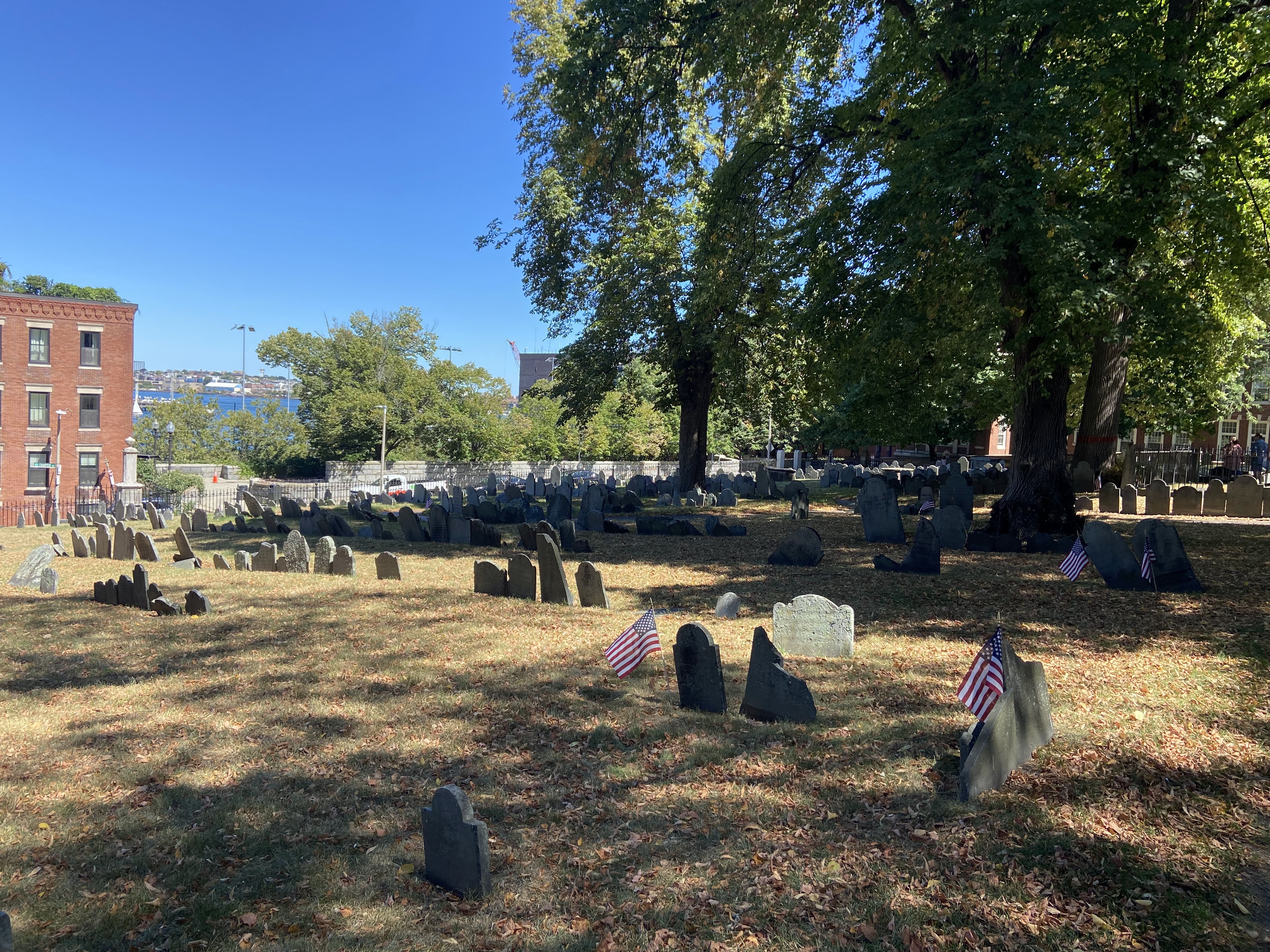
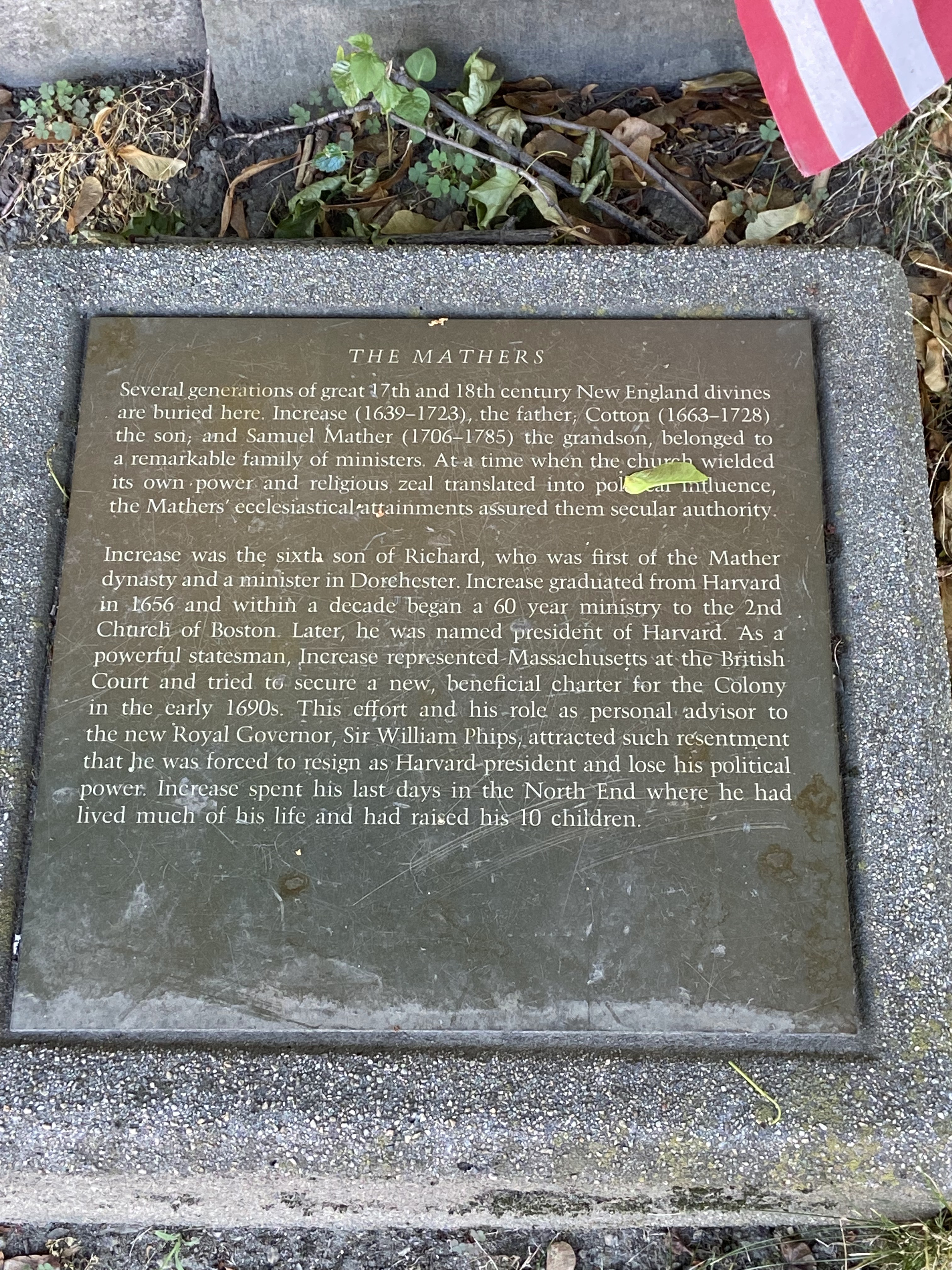
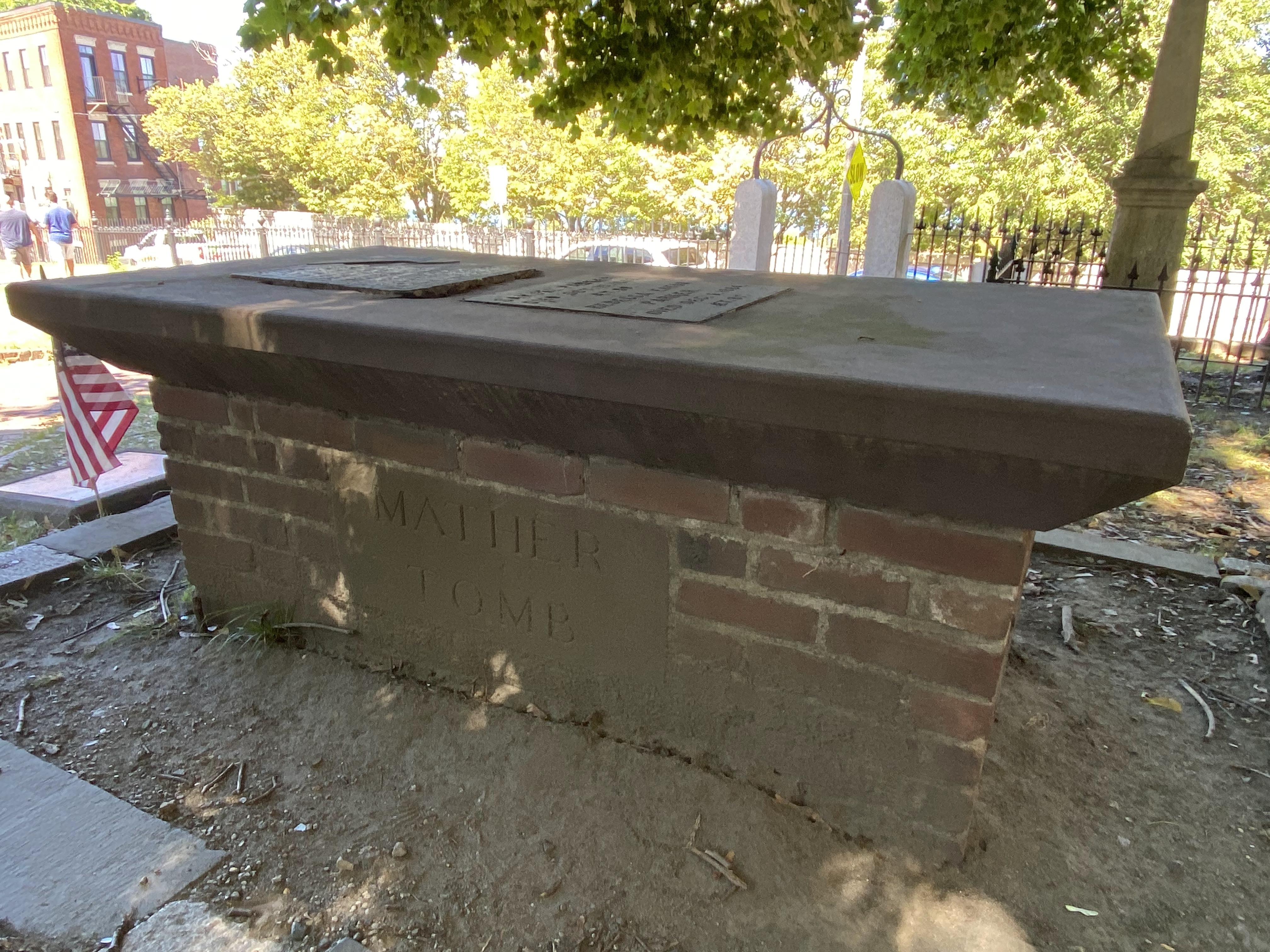
Cotton had 15 children, only 2 would outlive him. Cotton died in 1727 at age 65. He is buried in Copp’s Hill Burying Ground. The plaque next to his grave reads,
“Several generations of the great 17th and 18th century New England divines are buried here. Increase (1639-1723), the father of Cotton (1663-1728) the son and Samuel Mather (1706-1785) the grandson, belonged to a remarkable family of ministers. At a time when the church wielded its own power and religious zeal translated into political influence, the Mathers’ ecclesiastical attainments assured them secular authority.
Increase was the sixth son of Richard, who was the first of the Mather dynasty and a minster in Dorchester. Increase graduated from Harvard in 1656 and within a decade began a 60 year ministry to the 2nd Church of Boston. Later, he was named president of Harvard. As a powerful statesman, Increase represented Massachusetts at the British Court and tried to secure a new, beneficial charter for the Colony in the early 1690’s. This effort and his role as personal advisor to the new Royal Governor, Sir William Phips, attracted such resentment that he was forced to resign as Harvard president and lose his political power. Increase spent his last days in the North End where he had lived much of his life and had raised his 10 children.”
45 Hull St, Boston, MA
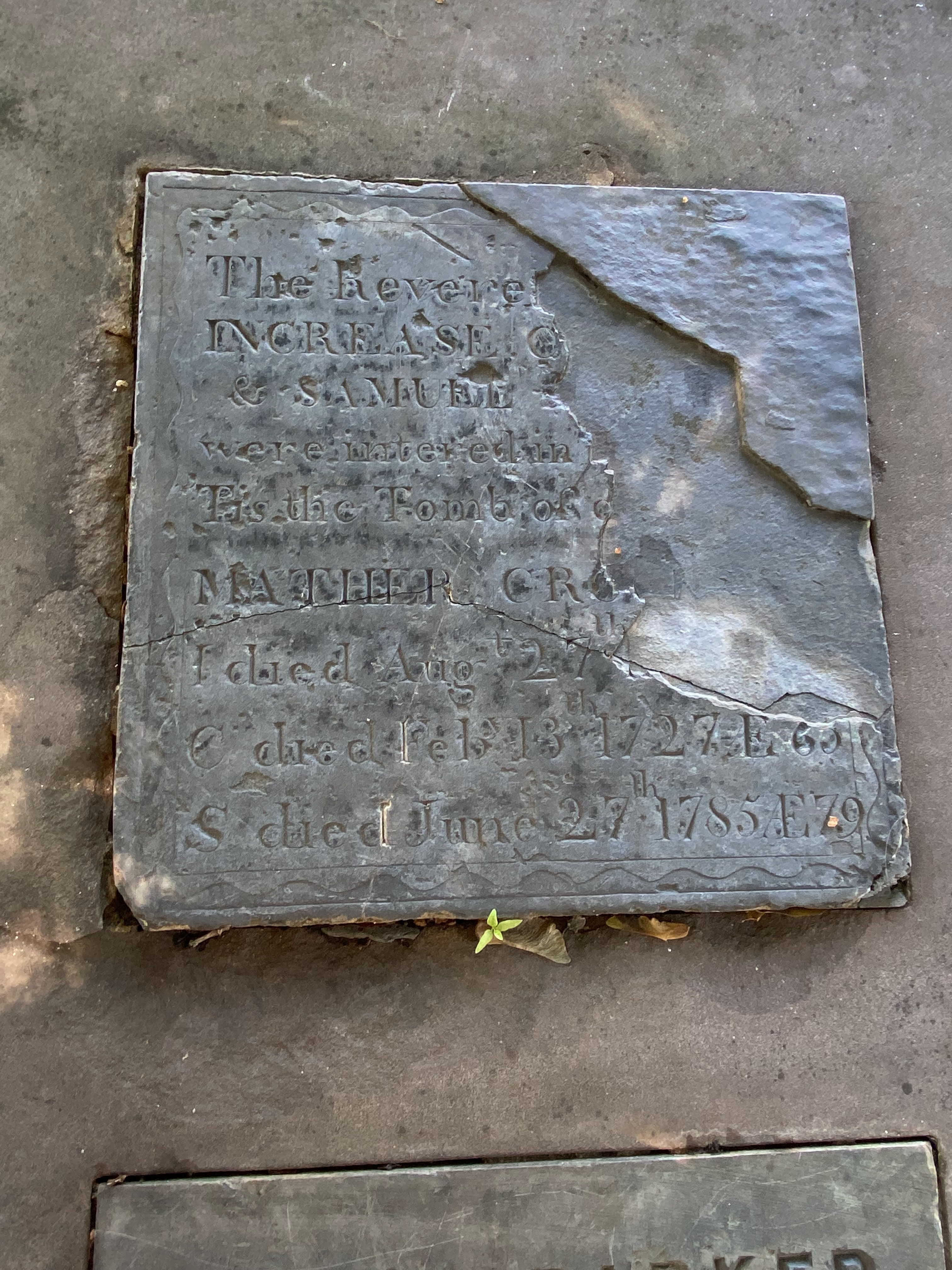
“The true legacy of Cotton Mather is one of an adoring husband, a gentle father, a loving pastor, a passionate preacher, a prolific writer, a generous philanthropist, a political figure, a soul-winning evangelist, a helpless sinner, and a sincere Christian.”
AP pg. 203
Other Resources:
John Eliot (1604-1690): “The Apostle to the Indians” Audio lecture
Cotton Mather and the Struggles of Early American Puritan Piety Phil Johnson lecture
The Life and Times of Cotton Mather: Silverman, Kenneth book
Forgotten Founder: Cotton Mather 5 Minutes in Church History audio
 Beside Old Hearthstones - An American Evangelical Church History Tour
Leave a comment